Jesus Christ
"Truly, truly, I say to you, unless one is born of water and the Spirit, he cannot enter the kingdom of God." John 3:5
I was taught very young that the scriptures were literally true, to interpret them in the context in which they were written, and to understand the meaning of the original language. Those who maintain that baptism has no sacramental effect on one's salvation are compelled to err on all these points. They must say that Jesus didn't mean "water, water", He was referring to something else such as the preached gospel or one's deep belief. If this be so then why should the word "Spirit' here mean "Spirit, Spirit"?. Water means water and Spirit means Spirit. One might debate a word in one scripture at length and would not be wise to form a doctrine around it, however the scripture further supports baptism as a regenerational means.
Titus 3:5 "It was for no reason other than his own faithful love that he saved us, by means of the cleansing water of rebirth and the renewal in the Holy Spirit." (See also Romans 6:3-4 and Col. 2:12-13)
The Early Church Fathers were united in their understanding of these scriptures and their practice and writings coincided. Water Baptism is the door to the Kingdom of God, not just a symbol, but a sacrament. The problem some may have with this evolves around the failure to see the Church as a community or corporate entity. The Church is saved together as we move toward righteousness. The view that one can be saved independent of the Church just by believing certain things or confessing a series of right words is a foreign one to the Apostles' teaching. The practice of baptism predates Christianity. The Jews had their Mikva baptizing entire families. With the New Covenant, baptism continued that practice but as an entry not to the Law but to the New Covenant of grace found in the Kingdom of God. To believe that baptism is anything other than a part of sacramental salvation is to say that the Founding Fathers of the Faith had it wrong from day one and that the original twelve Disciples must have done a poor job of discipling. Suspend your doctrinal ideology for a moment and see what the church has always taught and practiced concerning the role and purpose of baptism. (If you don't want to read the whole text just view the bolded sentences.)
Justin Martyr
"As many as are persuaded and believe that what we [Christians] teach and say is true, and undertake to be able to live accordingly, and instructed to pray and to entreat God with fasting, for the remission of their sins that are past, we pray and fast with them. Then they are brought by us where there is water and are regenerated in the same manner in which we were ourselves regenerated. For, in the name of God, the Father . . . and of our Savior Jesus Christ, and of the Holy Spirit [Matt. 28:19], they then receive the washing with water. For Christ also said, "Unless you are born again, you shall not enter into the kingdom of heaven" [John 3:3]" (First Apology 61 [A.D. 151]).
Irenaeus
"'And [Naaman] dipped himself . . . seven times in the Jordan' [2 Kgs. 5:14]. It was not for nothing that Naaman of old, when suffering from leprosy, was purified upon his being baptized, but [this served] as an indication to us. For as we are lepers in sin, we are made clean, by means of the sacred water and the invocation of the Lord, from our old transgressions, being spiritually regenerated as newborn babes, even as the Lord has declared: "Except a man be born again through water and the Spirit, he shall not enter into the kingdom of heaven." (Fragment 34 [A.D. 190]).
Tertullian
"[N]o one can attain salvation without baptism, especially in view of the declaration of the Lord, who says, "Unless a man shall be born of water, he shall not have life." (Baptism 12:1 [A.D. 203]).
Hippolytus
"The Father of immortality sent the immortal Son and Word into the world, who came to man in order to wash him with water and the Spirit; and he, begetting us again to incorruption of soul and body, breathed into us the Spirit of life, and endued us with an incorruptible panoply. If, therefore, man has become immortal, he will also be God. And if he is made God by water and the Holy Spirit after the regeneration of the laver he is found to be also joint-heir with Christ after the resurrection from the dead. Wherefore I preach to this effect: Come, all ye kindreds of the nations, to the immortality of the baptism" (Discourse on the Holy Theophany 8 [A.D. 217]).
The Recognitions of Clement"But you will perhaps say, 'What does the baptism of water contribute toward the worship of God?' In the first place, because that which has pleased God is fulfilled. In the second place, because when you are regenerated and born again of water and of God, the frailty of your former birth, which you have through men, is cut off, and so . . . you shall be able to attain salvation; but otherwise it is impossible. For thus has the true prophet [Jesus] testified to us with an oath: 'Verily, I say to you, that unless a man is born again of water . . . he shall not enter into the kingdom of heaven." (The Recognitions of Clement 6:9 [A.D. 221]).
Testimonies Concerning the Jews"That unless a man have been baptized and born again, he cannot attain unto the kingdom of God. In the Gospel according to John: 'Except a man be born again of water and the Spirit, he cannot enter into the kingdom of God.' [John 3:5]. . . . Also in the same place: 'Unless ye eat the flesh of the Son of man, and drink his blood, ye shall not have life in you.' [John 6:53]. That it is of small account to be baptized and to receive the Eucharist, unless one profit by it both in deeds and works." (Testimonies Concerning the Jews 3:2:25-26 [A.D. 240]).
Cyprian of Carthage
"[When] they receive also the baptism of the Church . . . then finally can they be fully sanctified and be the sons of God . . . since it is written, 'Except a man be born again of water and of the Spirit, he cannot enter into the kingdom of God." (Letters 71[72]:1 [A.D. 253]).
Council of Carthage VII"And in the gospel our Lord Jesus Christ spoke with his divine voice, saying, 'Except a man be born again of water and the Spirit, he cannot enter the kingdom of God. '. . . Unless therefore they receive saving baptism in the Catholic Church, which is one, they cannot be saved, but will be condemned with the carnal in the judgment of the Lord Christ." (Seventh Carthage [A.D. 256]).
Cyril of Jerusalem
"Since man is of a twofold nature, composed of body and soul, the purification also is twofold: the corporeal for the corporeal and the incorporeal for the incorporeal. The water cleanses the body, and the Spirit seals the soul. . . . When you go down into the water, then, regard not simply the water, but look for salvation through the power of the Spirit. For without both you cannot attain to perfection. It is not I who says this, but the Lord Jesus Christ, who has the power in this matter. And he says, 'Unless a man be born again," and he adds the words 'of water and of the Spirit', " he cannot enter the kingdom of God.' He that is baptized with water, but is not found worthy of the Spirit, does not receive the grace in perfection. Nor, if a man be virtuous in his deeds, but does not receive the seal by means of the water, shall he enter the kingdom of heaven. A bold saying, but not mine; for it is Jesus who has declared it." (Catechetical Lectures 3:4 [A.D. 350]).
Athanasius
"[A]s we are all from earth and die in Adam, so being regenerated from above of water and Spirit, in the Christ we are all quickened." (Four Discourses Against the Arians 3:26[33] [A.D. 360]).
Basil the Great
"This then is what it means to be 'born again of water and Spirit': Just as our dying is effected in the water [Rom. 6:3; Col. 2:12-13], our living is wrought through the Spirit. In three immersions and an equal number of invocations the great mystery of baptism is completed in such a way that the type of death may be shown figuratively, and that by the handing on of divine knowledge the souls of the baptized may be illuminated. If, therefore, there is any grace in the water, it is not from the nature of water, but from the Spirit's presence there." (The Holy Spirit 15:35 [A.D. 375]).
Ambrose of Milan
"Although we are baptized with water and the Spirit, the latter is much superior to the former, and is not therefore to be separated from the Father and the Son. There are, however, many who, because we are baptized with water and the Spirit, think that there is no difference in the offices of water and the Spirit, and therefore think that they do not differ in nature. Nor do they observe that we are buried in the element of water that we may rise again renewed by the Spirit. For in the water is the representation of death, in the Spirit is the pledge of life, that the body of sin may die through the water, which encloses the body as it were in a kind of tomb, that we, by the power of the Spirit, may be renewed from the death of sin, being born again in God." (The Holy Spirit 1:6[75-76] [A.D. 381]). "The Church was redeemed at the price of Christ's blood. Jew or Greek, it makes no difference; but if he has believed, he must circumcise himself from his sins [in baptism (Col. 2:11-12)] so that he can be saved . . . for no one ascends into the kingdom of heaven except through the sacrament of baptism. . . . "Unless a man be born again of water and the Holy Spirit, he cannot enter the kingdom of God." (Abraham 2:11:79-84 [A.D. 387]). "You have read, therefore, that the three witnesses in baptism are one: water, blood, and the Spirit (1 John 5:8): And if you withdraw any one of these, the sacrament of baptism is not valid. For what is the water without the cross of Christ? A common element with no sacramental effect. Nor on the other hand is there any mystery of regeneration without water, for 'unless a man be born again of water and the Spirit, he cannot enter the kingdom of God." (The Mysteries 4:20 [A.D. 390]).
Gregory of Nyssa
"[In] the birth by water and the Spirit, [Jesus] himself led the way in this birth, drawing down upon the water, by his own baptism, the Holy Spirit; so that in all things he became the firstborn of those who are spiritually born again, and gave the name of brethren to those who partook in a birth like to his own by water and the Spirit" (Against Eunomius 2:8 [A.D. 382]).
John Chrysostom
"[N]o one can enter into the kingdom of heaven except he be regenerated through water and the Spirit, and he who does not eat the flesh of the Lord and drink his blood is excluded from eternal life, and if all these things are accomplished only by means of those holy hands, I mean the hands of the priest, how will any one, without these, be able to escape the fire of hell, or to win those crowns which are reserved for the victorious? These [priests] truly are they who are entrusted with the pangs of spiritual travail and the birth which comes through baptism: by their means we put on Christ, and are buried with the Son of God, and become members of that blessed head [the Mystical Body of Christ]" (The Priesthood 3:5-6 [A.D. 387]).
Gregory of Nazianz
"Such is the grace and power of baptism; not an overwhelming of the world as of old, but a purification of the sins of each individual, and a complete cleansing from all the bruises and stains of sin. And since we are double-made, I mean of body and soul, and the one part is visible, the other invisible, so the cleansing also is twofold, by water and the Spirit; the one received visibly in the body, the other concurring with it invisibly and apart from the body; the one typical, the other real and cleansing the depths" (Oration on Holy Baptism 7-8 [A.D. 388]).
The Apostolic Constitutions
"Be ye likewise contented with one baptism alone, that which is into the death of the Lord [Rom. 6:3; Col. 2:12-13]. . . . [H]e that out of contempt will not be baptized shall be condemned as an unbeliever and shall be reproached as ungrateful and foolish. For the Lord says, 'Except a man be baptized of water and of the Spirit, he shall by no means enter into the kingdom of heaven.' And again, 'He that believes and is baptized shall be saved, but he that believes not shall be damned." [Mark 16:16] (Apostolic Constitutions 6:3:15 [A.D. 400]).
Augustine"It is this one Spirit who makes it possible for an infant to be regenerated . . . when that infant is brought to baptism; and it is through this one Spirit that the infant so presented is reborn. For it is not written, 'Unless a man be born again by the will of his parents' or 'by the faith of those presenting him or ministering to him,' but, 'Unless a man be born again of water and the Holy Spirit.' The water, therefore, manifesting exteriorly the sacrament of grace, and the Spirit effecting interiorly the benefit of grace, both regenerate in one Christ that man who was generated in Adam" (Letters 98:2 [A.D. 412]). "Those who, though they have not received the washing of regeneration, die for the confession of Christ, it avails them just as much for the forgiveness of their sins as if they had been washed in the sacred font of baptism. For he that said, 'If anyone is not reborn of water and the Spirit, he will not enter the kingdom of heaven,' made an exception for them in that other statement in which he says no less generally, 'Whoever confesses me before men, I too will confess him before my Father, who is in heaven." [Matt. 10:32] (The City of God 13:7 [A.D. 419]).
So, on what denominational tradition or on whose words do you base your doctrinal belief on baptism? "To be deep in history is to cease to be Protestant."
In their own words....
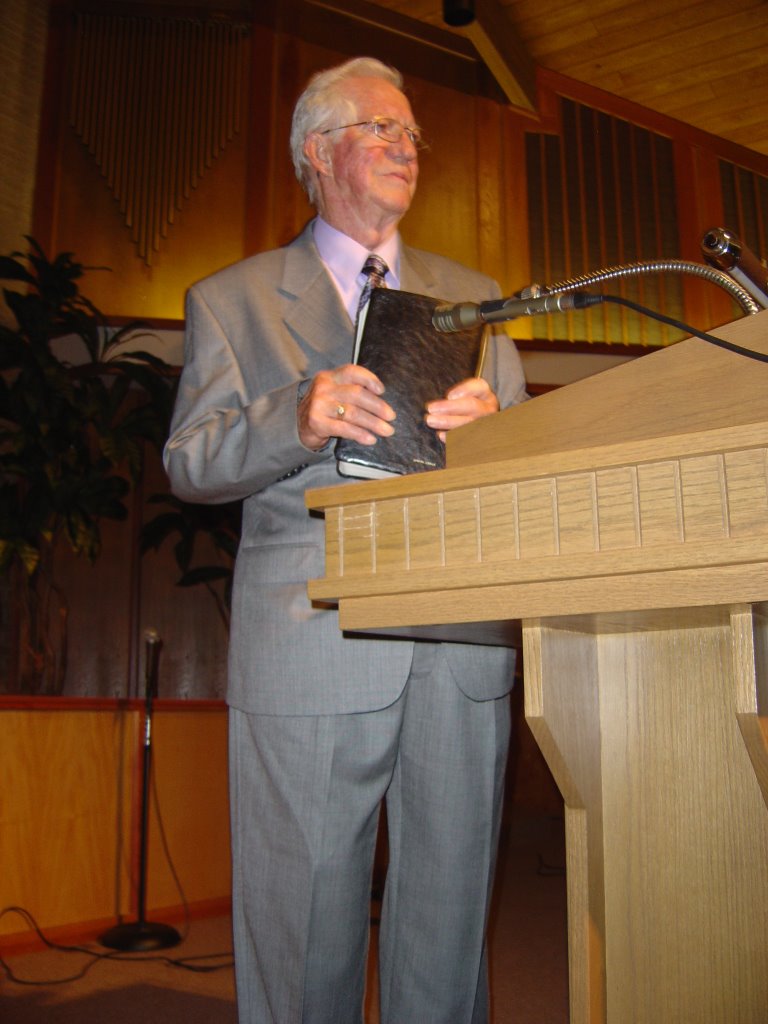 I received a comment from one of my sisters recently. She had recently read my article "Where I blew it with my children: A Father's recompense." (You can read her comment there). In my Journey To Orthodoxy I have refrained from discussing these things with any of my family members because I innately understood the propensity for my relatives to internalize my comments, making them a personal affront to their spirituality. (But alas, with this BLOG the cat is out of the bag.) Such is the nature of any dogmatic discussion, but more so when those you love are involved. One who makes this journey must expect to wade through a myriad of emotional responses, personal accusations, misread intentions, and extremes. I am an idealist at heart and an analytical thinker. I often make the miscalculation that others approach a discourse in the same way. I am often disappointed when that doesn't occur. For instance: The doctrinal theme of my article was: God as Punisher vs. God as Redeemer, The Total Depravity of Man vs. The Damaged Soul of Man. My sister wondered "what parents I had" and if I was saying she "was going to Hell". I fully understand the conclusions she has drawn but also see them as very unfortunate. I, too, saw my Protestant parents as loving and caring-the best in many ways. They brought me up in the church and taught me the respect of God and the meaning of life. It was my father who taught me the gospel message.
 It was my mother who showed me what it was to be a servant. I do not credit them for any of my weaknesses or propensity to sin. However, my journey has held a unique dilemma. My father was also my pastor and it was from his pulpit, among other venues, that I gained my understanding of doctrine and world view. The fact is, Baptists believe and teach through the doctrinal filter that man is totally depraved, as guilty as Adam and Eve and God is the punisher of sin. Although there is a measure of truth to these things, this is not the Orthodox Faith or ethos (Please reread the article for comparisons). To say that I heard these things preached throughout my life is a fact, to say that I am indicting my parents as the personal perpetrators of this doctrine in my life is not. It is a puzzling dichotomy that the home and the church should have two such differing influences. But in my case as a preacher's kid it is reasonable that I would not be able to separate the two.
 f Protestantism (*See UPDATE Below). Orthodoxy means "right belief". One aspect of that belief is the reticence to condemn other Christian individuals or groups. But another aspect is to proclaim loudly the Faith of the Apostles. It is in that proclaiming that the fires of dissent can ignite. The attitude of the Orthodox Christian should be "I know where the Church is but I don't know where it isn't". One can only hope to continue a dialogue with those relatives who will, and pray that there will be an absence of inferences and accusations and that no one brings a box of matches. It may be a formidable task, however, because "It's all relative."
 f Protestantism (*See UPDATE Below). Orthodoxy means "right belief". One aspect of that belief is the reticence to condemn other Christian individuals or groups. But another aspect is to proclaim loudly the Faith of the Apostles. It is in that proclaiming that the fires of dissent can ignite. The attitude of the Orthodox Christian should be "I know where the Church is but I don't know where it isn't". One can only hope to continue a dialogue with those relatives who will, and pray that there will be an absence of inferences and accusations and that no one brings a box of matches. It may be a formidable task, however, because "It's all relative."


