Translate

Sunday, July 09, 2006

"Freedom In Worship" or Is Orthodoxy Charismatic?

Before becoming Orthodox I spent six years in the Charismatic Episcopal Church (CEC). Much like the predominately convert Antiochian Orthodox Church of which I am now a part, the CEC consisted of Protestant Evangelicals who felt a strong pull back toward the roots of the historic faith. But even though they had dialogues with the Antiochian Orthodox Archdiocese, the founders of the CEC decided not to become Orthodox. Rather, they decided to form their own separate communion so they could have the "freedom" to remain "Charismatic" in doctrine and practice. During my time as a faithful CEC member I visited a Greek Orthodox Church with my CEC priest to hear an Orthodox convert speak. The main thing that intrigued us was the fact that this particular speaker was a former pastor of a Vineyard Church and thus a "Charismatic" as we understood the term. I had a desire to know what would motivate such a man, who believed in the gifts of tongues, healing, prophecy and the like and was involved in the entire Charismatic ethos, to switch to a "dead" liturgical church that didn't believe in the power of God or the "freedom" of the Holy Spirit. My actual question came out more like, "Having been a Charismatic, what part do the gifts of the Spirit play in the Orthodox Church.?" He answered, "I have found that the Orthodox Church is the most charismatic Church on the planet." That one statement was enough to start me on my quest for truth in this area. But he added more fuel when he said, "I finally had to admit to myself that much of what I saw such as "prophecies" in public meetings and to individuals turned out to be false and could not be authenticated." So that was a double whammy. As I researched his two assertions, I found them both to be true. The charisms have always been in the Orthodox Church throughout all of history. Saints were given names like John the Wonder Worker, because of the power of the supernatural gifts that poured through their lives. The monastic orders saw and continue to see the supernatural elements of the faith throughout all of history. The sacrament of Holy Unction, for the healing of the body by the anointing of Holy Oil, is a normative practice. All of the gifts of the Spirit found in the scriptures are considered Orthodox. But the question is: Are the gifts being demonstrated authentically and are the venues in which they are being demonstrated scriptural or profitable venues?

THE CH
ARISMATIC CULTURE
As a former Evangelical Charismatic, now Orthodox, I have become aware that the Charismatic culture is simply another denominational substitute for the Faith of the Fathers. In fact, it is predominately western in nature, particularly having its origins in America. The obstacle most Charismatics face when considering the Orthodox Faith is not the validity of the scriptural gifts themselves, but the methods and application of the gifts, especially in corporate worship. I had a conversation with a Charismatic minister recently and in trying to answer his questions about Orthodoxy was confronted with his presumptive dogma. He asked me if we had the "power" of the Holy Spirit. I knew instinctively, having been where he is, that he was not asking about the existence of the power of the Holy Spirit but whether or not the Orthodox Church allowed the demonstration of certain gifts and manifestations in the same manner and venue that he embraced. He asked me specifically about the gift of healing. I explained to him the sacrament of Holy Unction and how the Holy Chrism or Oil is blessed by the Bishops of the church to anoint the sick. He seemed satisfied with my answer until he realized that we didn't allow for that sacrament during every Sunday service. He just kept repeating, "See, you don't have the power. You've got to have the power!" Not even my explanation that we did have Holy Unction Services at other times just for the sick and that we pray for individuals at other times according to the needs, would satisfy him. Because we didn't "flow with the Spirit" in our Church services as he saw it, we were powerless and not Charismatic. I have discovered that elements of this mindset permeate much of the resistance some Charismatics have toward the Orthodox Faith. Their desire to have "freedom in worship" means they want to sing certain types of music and change things up if "the Spirit leads." "What if someone wants to give a prophecy or a message in tongues during a service", they ask, "we have to give the Holy Spirit freedom." Having been a Charismatic minister I understand all too well the cultural idea that to have a plan or agenda in a given corporate worship service is considered limiting the Holy Spirit. It is the mantra of many Charismatic pastors or leaders to begin a corporate meeting with the words, "We have no agenda here, we're just going to let the Holy Spirit do what he wants to do." This brings us to our former Vineyard Pastor's second assertion. What really are the results of this cultural atmosphere of "free" worship? What has it actually produced and what is just smoke and mirrors? One writer has said,
"What scares me is the anti-intellectual, anti-critical-thinking philosophy that has spilled over into the church. This philosophy tends to romanticize the faith, making the local church into an "experience center" . . . Their concept of "church" is that they are spiritual consumers and that the church's job is to meet their needs."
 
From this modern western Charismatic ethos has come the promotion of the individual. They either say they must go to a church where they "feel comfortable" or where they can publicly display their spirituality by demonstrating their spiritual gifts. Public demonstrations have become such a traditional, cultural part of the worship services that unless such demonstrations occur it is determined the Holy Spirit didn't "show up." It is in this unscriptural and unhistorical cultural atmosphere that error is bred and false unaccountable demonstrations occur.


WH
ERE IS THE VALIDITY?
Just so you will fully understand my perspective please know that I am considered a prophetic person. (Although I don't claim to be a Prophet). I have given prophetic words by the will of God in public and in private. I have seen angels and have experienced spiritual visions and dreams. I have been a Charismatic musician and worship leader, and have written many worship songs. I have danced in the spirit, spoken in tongues and been "slain in the spirit". I have also served on staff at several non-denominational Charismatic Churches as worship leader and associate pastor. I believe fully the power of the Holy Spirit and the existence of all the gifts that are found in Him. What I have discovered and what I have had to humbly admit is that much of what I saw in the Charismatic Movement was not authentic; in fact much of what I saw and experienced was wrought with deception. Although we should not judge the motive of people's hearts, we have the responsibility to judge the results of that done in the name of Christ. My most shocking epiphany was when I realized that 99.9 % of the so-called miracles, healings, and prophetic words were nothing more than anecdotal fables, wishful thinking, or soulish activity that could not be verified. Not only could they not be verified but in most cases there is no requirement that they be verified. Because so much of the Charismatic manifestations have been proven to be false, a new twist on a scriptural doctrine has had to be embraced. One Charismatic leader states the premise of this new doctrine concerning prophetic words, "In Pentecostal circles, we differentiate between primary revelation, which is the Bible and which we consider infallible, and secondary revelation prophetic utterances that we do not consider infallible." So to them it is okay to give an erroneous "prophetic word" that directly affects the response and lives of individuals with no accountability toward its authenticity. When it comes to the thousands of healing "miracles" that don't take, the doctrine is espoused that either they didn't have enough faith, they need to work to "keep their healing", or they just received a partial healing. An honest student will have to admit that ALL of the scriptural healings were 100% and unquestionable and if a prophet erred in even one point of his message he was deemed a false prophet and was stoned. As a former Evangelical Charismatic, my eyes were really opened when I began to read actual documentation of prophecies and healings that were verifiably false (See www.deceptioninthechurch.com). What was especially shocking was the blatant false doctrines also espoused by the prophets and healers such as, "You don't have God in you. You are a God!", the belief that God consists of nine parts not three, and the uncanny parallels between the latest manifestations happening in the latest Charismatic revivals and the cults of the eastern gurus (See www.bible.ca/tongues.htm). Without going into a thorough apologetic discourse to these points I will trust the integrity of your search to discover the accuracy of this assessment.
HOW THE EARLY CHURCH REALLY WORSHIPED
One of the paradigm shifts that I experienced, concerns methods of worship and the misconception of how the Early Church worshiped. I assumed and was taught that what we did as modern Charismatics was a model of the early Church. I had the idea that the Early Church met in homes, sat around in circles, and spontaneously (without any agenda) began to sing contemporary songs, say impromptu prayers, give sermons, and quote their favorite scripture as the "Spirit led". Using the list of gifts found in the scriptures, I imagined that at any given time in a corporate gathering, an individual might stand up and deliver a corporate or personal prophecy, a message in tongues, or suggest, "I just feel we need to pray for Miriam right now." It was a given that this might go on for several hours or until the atmosphere ebbed or it was deemed that the Spirit was finished doing "His" work. (I highly recommend that you study the early heresy of Montanism, which parallels much of the Evangelical Charismatic mindset today. Around c. 156 A.D., a so-called prophet named Montanus launched a very charismatic environment, believing that the Holy Spirit spoke directly through him, and his followers. Montanists believed that they were receiving Divine Revelation, like the Old Testament prophets. The concern among the Bishops of the Church was that such emphasis on new prophetic revelation whether corporate or personal might be viewed on the same level as Holy Scripture and could interfere with people's understanding of the core message of the Scriptures and the pragmatic servanthood required to be a grounded Christian. Does this sound familiar?) Make no mistake, there is authentic prophecy. I, myself, have given revelatory personal words of prophetic wisdom to individuals and Church leaders since becoming Orthodox, but not in a public worship service! It is not needed, is not necessary, and is, frankly, not what the worship service is for. The Church embraces all the gifts but not the modern heresy- based method in which it has been promoted.
COMPARE THE ORTHODOX AND CHARISMATIC WORSHIP ETHOS
There is a vast difference in the worship ethos of the west and that of historic Christianity which has its ethos origins in the east. Evangelical Charismatics value highly the idea of the invisible church or "everyone is a priest" doctrine and thus devalue the sanctity of worship implements or places of worship. Charismatics are comfortable calling their buildings auditoriums or centers. Even those who refer to their places of worship as "sanctuaries" have no qualms about taking cokes or coffee inside or having ordinary conversations of earthly matters. With few exceptions they enter into the building to the sound of a loud roar of conversation. The "call to order" is usually the band or choir striking up the music causing all to scramble to their seats. In Orthodoxy the word "sanctuary" is taken literally. The Temple is specifically "set apart" for the worship of God. The architecture itself lends itself to the Old Testament Temple with the outer court, the inner court, and Holy of Holies. Where individual expression is the hallmark for worshipers in an Evangelical Charismatic service, in Orthodoxy the goal is for all to worship with one voice. Each person enters the door in reverence and quietness paying respect to the Saints who have gone on before by venerating their pictures. They then enter the inner court and light candles, pray, and bow in the direction of the Holy of Holies where the Altar rests. There is always an awareness that one is in the presence of the Holy Trinity, the Host of Angels, and the Great Cloud of Witnesses who are the Saints that continue to worship around the throne of God with us. 90% of the Liturgy is scripture and sung corporately to the Trinity and the people stand 90% of the time out of respect for what is being said and done. The contents of the gospel book are revered and people show respect by kissing the cover as the priest presents it. The priest is shown honor and respect as he represents Christ to the people. Some touch the hem of his vestment as he passes in remembrance of Christ passing by or kiss his right hand when greeting him because it is that hand that blesses and holds the Eucharist. The Altar area itself is reserved only for those who are sanctified to minister there. It is not treated as a common area or a simple platform stage as in most Evangelical Charismatic Churches. If something comes in contact with the Altar it is treated as holy and with respect. The public Charismatic expressions have always been subject to confusion and infiltration of error and always considered an aberration of the shape and ethos of Christian Worship. Saint Saraphim of Sarov (1759-1833) who once spent 1000 days and nights in prayer on a rock and later died in the kneeling position while in prayer, speaks of the ethos of holiness required by all who come to corporate worship:
"Never, God forbid, not for anything, not for anyone, should one speak in the sanctuary. Even if one were to have to suffer for it. For the Lord Himself is present there and in fear and trembling all the Cherubim and Seraphim and all the powers of God stand before him. Who then will speak before his face? Even when wiping the dust and sweeping the dirt from the Temple of God, one should not throw it carelessly anywhere. Even the dust of the temple of God is sacred. And the water also to be poured into a special clean place. There is no higher obedience than a church obedience and were it only to wipe the floor of the house of the Lord with a cloth this will be counted higher than any other action by God!"
What a drastic contrast to the noisy self-promoting environment of the Evangelical Charismatic ethos where the criteria for spirituality is how well one can prophecy or how "anointed" the music set was!
THE TRUE MODEL OF WORSHIP
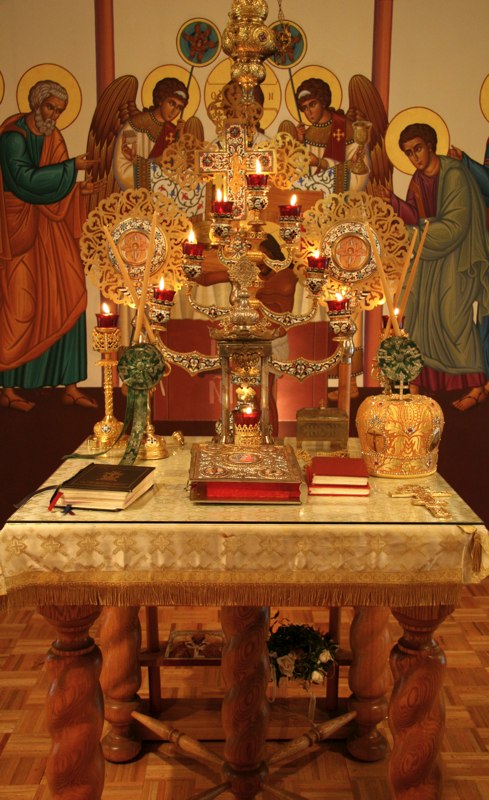
What I discovered through the perusing of history and the writings of the Early Church Fathers was that it is the Orthodox Church that is the model of the early Church worship not the modern Charismatic culture. The early Christians were Jewish. They continued to worship at the synagogue on Saturday and to meet in houses on Sunday, or what came to be known as The Lord's Day. As the Lord's Day meetings continued to develop they continued the structure and order of the synagogue services. It was anything but the free-wheeling "no agenda" atmosphere. Everything was done "decently and in order" as Paul would later state when the Corinthians public usage of some of the spiritual gifts became unbalanced and led to confusion. The work or praise of the people (liturgy) was centered around the Eucharist and all that led up to the partaking of it was designed to tell the whole gospel story. History has provided us with documentation to this effect. In Justin Martyr's First Apology, c. 150 A.D we see the shape of the Liturgical service that the Church has preserved even to today.
"And on the day called Sunday, all who live in cities or in the country gather together to one place, and the memoirs of the apostles or the writings of the prophets are read, as long as time permits; then, when the reader has ceased, the president verbally instructs, and exhorts to the imitation of these good things.Then we all rise together and pray, and, as we before said, when our prayer is ended, bread and wine and water are brought, and the president in like manner offers prayers and thanksgivings, according to his ability, and the people assent, saying Amen; and there is a distribution to each, and a participation of that over which thanks have been given, and to those who are absent a portion is sent by the deacons. And they who are well to do, and willing, give what each thinks fit; and what is collected is deposited with the president, who succors the orphans and widows and those who, through sickness or any other cause, are in want, and those who are in bonds and the strangers sojourning among us, and in a word takes care of all who are in need. But Sunday is the day on which we all hold our common assembly, because it is the first day on which God, having wrought a change in the darkness and matter, made the world;and Jesus Christ our Savior on the same day rose from the dead. For He was crucified on the day before that of Saturn (Saturday); and on the day after that of Saturn, which is the day of the Sun, having appeared to His apostles and disciples, He taught them these things, which we have submitted to you also for your consideration."

So, does the worship in the Orthodox Church look Charismatic as we have discussed? The answer is "no". But I would not trade one Liturgy for all the Charismatic "freedom" in the world. One of the greatest spiritual moments I have had since becoming Orthodox was during the Liturgy. As we were all singing, suddenly my propensity for individual desires, personal tastes and preferences in worship based on my own cultural passions fell away and I became part of the whole. We were all singing with one voice. Let me say it again: it was as if one person was singing. I didn't lose my own identity and yet it was melded with the others present and the Saints of the ages who were also present just as the Church has maintained for 2000 years. The Charismatic world has many catch-phrases, one of them being "open heaven". You might hear someone say, "We are praying for an open heaven," or, in reference to the newest Charismatic movement, "There is an open heaven over there." Heaven is truly open every time the Orthodox Liturgy ("work" or "glory" of the people) takes place and we have, not just some ethereal move of the Holy Spirit, but the fullness of the Holy Trinity in our midst and we actually take the Presence of Christ into our bodies by way of the Eucharist.
ORTHODOXY IS REAL FREEDOM
Until now you may have sincerely embraced the Charismatic because it is what you have known and I am sure there has been some value and comfort to you in it. Take heart as you Journey to Orthodoxy. There is room for expressions of worship outside the Liturgy through concerts, CD's and the like. In fact it may encourage you to know, being that our Orthodox Church is located in Nashville, we have as members, several contemporary Christian recording artists who don't feel a lack of freedom at all and whose CD's are available on our own Orthodox Bookstore. We have also had wonderful times of worship in Church fellowships and our annual talent show where different expressions are given freedom. There is also a place and proper time to move within all of the gifts of the Holy Spirit under the umbrella of the "One Holy, Catholic, and Apostolic Church." Just remember, it is the Charismatic culture you have been living in that is the foreign one and not Orthodoxy. Orthodoxy is meant for you and you are meant for it. My wife and I and our children found this out first hand when we stepped into the Orthodox faith. We knew it was The Faith but also knew that the culture and customs of it might be a shock to our senses. So, we agreed to attend the Liturgy in an Antiochian Orthodox Church for three months before deciding whether or not we "liked" it. I am happy to say, it didn't take that long. The best is yet to come for you in the fullness and the worship of the Church. You are meant to become part of the whole. Don't fear what the Church of the Living Trinity has preserved for all of the body of Christ for hundreds of years. The Holy Trinity is waiting to meet you there as are the myriads of other former Evangelical Charismatics which includes all the saints of the ages who have come before you. May God continue to bless you in your Journey to Orthodoxy.

Tuesday, June 06, 2006

It's All Relative

I received a comment from one of my sisters recently. She had recently read my article "Where I blew it with my children: A Father's recompense." (You can read her comment there). In my Journey To Orthodoxy I have refrained from discussing these things with any of my family members because I innately understood the propensity for my relatives to internalize my comments, making them a personal affront to their spirituality. (But alas, with this BLOG the cat is out of the bag.) Such is the nature of any dogmatic discussion, but more so when those you love are involved. One who makes this journey must expect to wade through a myriad of emotional responses, personal accusations, misread intentions, and extremes. I am an idealist at heart and an analytical thinker. I often make the miscalculation that others approach a discourse in the same way. I am often disappointed when that doesn't occur. For instance: The doctrinal theme of my article was: God as Punisher vs. God as Redeemer, The Total Depravity of Man vs. The Damaged Soul of Man. My sister wondered "what parents I had" and if I was saying she "was going to Hell". I fully understand the conclusions she has drawn but also see them as very unfortunate. I, too, saw my Protestant parents as loving and caring-the best in many ways. They brought me up in the church and taught me the respect of God and the meaning of life. It was my father who taught me the gospel message.

It was my mother who showed me what it was to be a servant. I do not credit them for any of my weaknesses or propensity to sin. However, my journey has held a unique dilemma. My father was also my pastor and it was from his pulpit, among other venues, that I gained my understanding of doctrine and world view. The fact is, Baptists believe and teach through the doctrinal filter that man is totally depraved, as guilty as Adam and Eve and God is the punisher of sin. Although there is a measure of truth to these things, this is not the Orthodox Faith or ethos (Please reread the article for comparisons). To say that I heard these things preached throughout my life is a fact, to say that I am indicting my parents as the personal perpetrators of this doctrine in my life is not. It is a puzzling dichotomy that the home and the church should have two such differing influences. But in my case as a preacher's kid it is reasonable that I would not be able to separate the two.

I do not have the right to characterize the state of anyone's soul, thus their eternal destiny. I do not even have the right to my own personal doctrinal opinions. That is not Orthodox. What I do have is the responsibility to seek out the truth of the undivided church, that which was "taught at all times, in all places, by all the Church". That is Orthodox. By necessity, some of these discoveries will smack in the face of some Protestant doctrinal stances and ideologies and therefore smack in the face of those family members who still hold to them. Smacking is not the heart or intent nor is it the Orthodox ethos. I have found the Orthodox ethos to be one of love and inclusion. For instance, when I was received into the Church, my baptism was accepted as authentic. This was the baptism by immersion administered by my own father. Entry in to the Orthodox faith "completed" what was begun in my years of Protestantism (*See UPDATE Below). Orthodoxy means "right belief". One aspect of that belief is the reticence to condemn other Christian individuals or groups. But another aspect is to proclaim loudly the Faith of the Apostles. It is in that proclaiming that the fires of dissent can ignite. The attitude of the Orthodox Christian should be "I know where the Church is but I don't know where it isn't". One can only hope to continue a dialogue with those relatives who will, and pray that there will be an absence of inferences and accusations and that no one brings a box of matches. It may be a formidable task, however, because "It's all relative."

* UPDATE 7/21/14: This article was originally written on 6/6/06. I subsequently learned that, although the reception of my Baptist baptism may have been a sign of "love and inclusion" by the Antiochians, that practice is highly irregular and is not in keeping with the canons of the church. For more on this read Why We Left, Where We Went.

Monday, June 05, 2006

My Beloved Priest

This is my beloved priest, Father Steven Rogers of St. Ignatius Antiochian Orthodox Church in Franklin, TN.
I feel a special affinity with him not only because he was the first to serve me the Holy Eucharist but because he, too, is a former Southern Baptist. Father Steven started his career as a journalist and didn't become a priest until his early forties. He has been senior priest at Saint Ignatius for 10 years. I have been blessed to see his heart of compassion toward the people whose souls he guards. He is quick to tears of compassion and strong to rebuke or correct in love. He is quick to wit and humor and strong to teach and expound the principals of the faith. The mark of a man's character is proven not by what one says to his face but by what one says behind his back. I have always heard only praise for this man of God. The only weakness I have spotted in Father Steven is the propensity to devote too much time and effort to the work of the ministry. Oh, that I might emulate that weakness! The only criticism I have heard is that Father Steven has a monastic heart of devotion toward his service to the Church and expects his parishioners to have the same. Oh, that I might be criticized thus! I always look for him to come near me when at the Temple, not because I desire his attention, but because I desire to offer my open hands to him, say the words "Father Bless", and kiss his right hand that blesses and offers me the Holy Eucharist from the Holy Altar. I pray that I may be an Aaron to this Moses his next 10 years as he leads the people toward the promises of the Kingdom of God.

Sunday, June 04, 2006

In Their Own Words- "Baptism Saves You"

Jesus Christ
"Truly, truly, I say to you, unless one is born of water and the Spirit, he cannot enter the kingdom of God." John 3:5

I was taught very young that the scriptures were literally true, to interpret them in the context in which they were written, and to understand the meaning of the original language. Those who maintain that baptism has no sacramental effect on one's salvation are compelled to err on all these points. They must say that Jesus didn't mean "water, water", He was referring to something else such as the preached gospel or one's deep belief. If this be so then why should the word "Spirit' here mean "Spirit, Spirit"?. Water means water and Spirit means Spirit. One might debate a word in one scripture at length and would not be wise to form a doctrine around it, however the scripture further supports baptism as a regenerational means.

Titus 3:5 "It was for no reason other than his own faithful love that he saved us, by means of the cleansing water of rebirth and the renewal in the Holy Spirit." (See also Romans 6:3-4 and Col. 2:12-13)

The Early Church Fathers were united in their understanding of these scriptures and their practice and writings coincided. Water Baptism is the door to the Kingdom of God, not just a symbol, but a sacrament. The problem some may have with this evolves around the failure to see the Church as a community or corporate entity. The Church is saved together as we move toward righteousness. The view that one can be saved independent of the Church just by believing certain things or confessing a series of right words is a foreign one to the Apostles' teaching. The practice of baptism predates Christianity. The Jews had their Mikva baptizing entire families. With the New Covenant, baptism continued that practice but as an entry not to the Law but to the New Covenant of grace found in the Kingdom of God. To believe that baptism is anything other than a part of sacramental salvation is to say that the Founding Fathers of the Faith had it wrong from day one and that the original twelve Disciples must have done a poor job of discipling. Suspend your doctrinal ideology for a moment and see what the church has always taught and practiced concerning the role and purpose of baptism. (If you don't want to read the whole text just view the bolded sentences.)

Justin Martyr
"As many as are persuaded and believe that what we [Christians] teach and say is true, and undertake to be able to live accordingly, and instructed to pray and to entreat God with fasting, for the remission of their sins that are past, we pray and fast with them. Then they are brought by us where there is water and are regenerated in the same manner in which we were ourselves regenerated. For, in the name of God, the Father . . . and of our Savior Jesus Christ, and of the Holy Spirit [Matt. 28:19], they then receive the washing with water. For Christ also said, "Unless you are born again, you shall not enter into the kingdom of heaven" [John 3:3]" (First Apology 61 [A.D. 151]).
Irenaeus
"'And [Naaman] dipped himself . . . seven times in the Jordan' [2 Kgs. 5:14]. It was not for nothing that Naaman of old, when suffering from leprosy, was purified upon his being baptized, but [this served] as an indication to us. For as we are lepers in sin, we are made clean, by means of the sacred water and the invocation of the Lord, from our old transgressions, being spiritually regenerated as newborn babes, even as the Lord has declared: "Except a man be born again through water and the Spirit, he shall not enter into the kingdom of heaven." (Fragment 34 [A.D. 190]).
Tertullian
"[N]o one can attain salvation without baptism, especially in view of the declaration of the Lord, who says, "Unless a man shall be born of water, he shall not have life." (Baptism 12:1 [A.D. 203]).
Hippolytus
"The Father of immortality sent the immortal Son and Word into the world, who came to man in order to wash him with water and the Spirit; and he, begetting us again to incorruption of soul and body, breathed into us the Spirit of life, and endued us with an incorruptible panoply. If, therefore, man has become immortal, he will also be God. And if he is made God by water and the Holy Spirit after the regeneration of the laver he is found to be also joint-heir with Christ after the resurrection from the dead. Wherefore I preach to this effect: Come, all ye kindreds of the nations, to the immortality of the baptism" (Discourse on the Holy Theophany 8 [A.D. 217]).
The Recognitions of Clement"But you will perhaps say, 'What does the baptism of water contribute toward the worship of God?' In the first place, because that which has pleased God is fulfilled. In the second place, because when you are regenerated and born again of water and of God, the frailty of your former birth, which you have through men, is cut off, and so . . . you shall be able to attain salvation; but otherwise it is impossible. For thus has the true prophet [Jesus] testified to us with an oath: 'Verily, I say to you, that unless a man is born again of water . . . he shall not enter into the kingdom of heaven." (The Recognitions of Clement 6:9 [A.D. 221]).
Testimonies Concerning the Jews"That unless a man have been baptized and born again, he cannot attain unto the kingdom of God. In the Gospel according to John: 'Except a man be born again of water and the Spirit, he cannot enter into the kingdom of God.' [John 3:5]. . . . Also in the same place: 'Unless ye eat the flesh of the Son of man, and drink his blood, ye shall not have life in you.' [John 6:53]. That it is of small account to be baptized and to receive the Eucharist, unless one profit by it both in deeds and works." (Testimonies Concerning the Jews 3:2:25-26 [A.D. 240]).
Cyprian of Carthage
"[When] they receive also the baptism of the Church . . . then finally can they be fully sanctified and be the sons of God . . . since it is written, 'Except a man be born again of water and of the Spirit, he cannot enter into the kingdom of God." (Letters 71[72]:1 [A.D. 253]).

Council of Carthage VII"And in the gospel our Lord Jesus Christ spoke with his divine voice, saying, 'Except a man be born again of water and the Spirit, he cannot enter the kingdom of God. '. . . Unless therefore they receive saving baptism in the Catholic Church, which is one, they cannot be saved, but will be condemned with the carnal in the judgment of the Lord Christ." (Seventh Carthage [A.D. 256]).
Cyril of Jerusalem
"Since man is of a twofold nature, composed of body and soul, the purification also is twofold: the corporeal for the corporeal and the incorporeal for the incorporeal. The water cleanses the body, and the Spirit seals the soul. . . . When you go down into the water, then, regard not simply the water, but look for salvation through the power of the Spirit. For without both you cannot attain to perfection. It is not I who says this, but the Lord Jesus Christ, who has the power in this matter. And he says, 'Unless a man be born again," and he adds the words 'of water and of the Spirit', " he cannot enter the kingdom of God.' He that is baptized with water, but is not found worthy of the Spirit, does not receive the grace in perfection. Nor, if a man be virtuous in his deeds, but does not receive the seal by means of the water, shall he enter the kingdom of heaven. A bold saying, but not mine; for it is Jesus who has declared it." (Catechetical Lectures 3:4 [A.D. 350]).
Athanasius
"[A]s we are all from earth and die in Adam, so being regenerated from above of water and Spirit, in the Christ we are all quickened." (Four Discourses Against the Arians 3:26[33] [A.D. 360]).

Basil the Great
"This then is what it means to be 'born again of water and Spirit': Just as our dying is effected in the water [Rom. 6:3; Col. 2:12-13], our living is wrought through the Spirit. In three immersions and an equal number of invocations the great mystery of baptism is completed in such a way that the type of death may be shown figuratively, and that by the handing on of divine knowledge the souls of the baptized may be illuminated. If, therefore, there is any grace in the water, it is not from the nature of water, but from the Spirit's presence there." (The Holy Spirit 15:35 [A.D. 375]).
Ambrose of Milan
"Although we are baptized with water and the Spirit, the latter is much superior to the former, and is not therefore to be separated from the Father and the Son. There are, however, many who, because we are baptized with water and the Spirit, think that there is no difference in the offices of water and the Spirit, and therefore think that they do not differ in nature. Nor do they observe that we are buried in the element of water that we may rise again renewed by the Spirit. For in the water is the representation of death, in the Spirit is the pledge of life, that the body of sin may die through the water, which encloses the body as it were in a kind of tomb, that we, by the power of the Spirit, may be renewed from the death of sin, being born again in God." (The Holy Spirit 1:6[75-76] [A.D. 381]). "The Church was redeemed at the price of Christ's blood. Jew or Greek, it makes no difference; but if he has believed, he must circumcise himself from his sins [in baptism (Col. 2:11-12)] so that he can be saved . . . for no one ascends into the kingdom of heaven except through the sacrament of baptism. . . . "Unless a man be born again of water and the Holy Spirit, he cannot enter the kingdom of God." (Abraham 2:11:79-84 [A.D. 387]). "You have read, therefore, that the three witnesses in baptism are one: water, blood, and the Spirit (1 John 5:8): And if you withdraw any one of these, the sacrament of baptism is not valid. For what is the water without the cross of Christ? A common element with no sacramental effect. Nor on the other hand is there any mystery of regeneration without water, for 'unless a man be born again of water and the Spirit, he cannot enter the kingdom of God." (The Mysteries 4:20 [A.D. 390]).
Gregory of Nyssa
"[In] the birth by water and the Spirit, [Jesus] himself led the way in this birth, drawing down upon the water, by his own baptism, the Holy Spirit; so that in all things he became the firstborn of those who are spiritually born again, and gave the name of brethren to those who partook in a birth like to his own by water and the Spirit" (Against Eunomius 2:8 [A.D. 382]).
John Chrysostom
"[N]o one can enter into the kingdom of heaven except he be regenerated through water and the Spirit
, and he who does not eat the flesh of the Lord and drink his blood is excluded from eternal life, and if all these things are accomplished only by means of those holy hands, I mean the hands of the priest, how will any one, without these, be able to escape the fire of hell, or to win those crowns which are reserved for the victorious? These [priests] truly are they who are entrusted with the pangs of spiritual travail and the birth which comes through baptism: by their means we put on Christ, and are buried with the Son of God, and become members of that blessed head [the Mystical Body of Christ]" (The Priesthood 3:5-6 [A.D. 387]).
Gregory of Nazianz
"Such is the grace and power of baptism; not an overwhelming of the world as of old, but a purification of the sins of each individual, and a complete cleansing from all the bruises and stains of sin. And since we are double-made, I mean of body and soul, and the one part is visible, the other invisible, so the cleansing also is twofold, by water and the Spirit; the one received visibly in the body, the other concurring with it invisibly and apart from the body; the one typical, the other real and cleansing the depths" (Oration on Holy Baptism 7-8 [A.D. 388]).

The Apostolic Constitutions
"Be ye likewise contented with one baptism alone, that which is into the death of the Lord [Rom. 6:3; Col. 2:12-13]. . . . [H]e that out of contempt will not be baptized shall be condemned as an unbeliever and shall be reproached as ungrateful and foolish. For the Lord says, 'Except a man be baptized of water and of the Spirit, he shall by no means enter into the kingdom of heaven.' And again, 'He that believes and is baptized shall be saved, but he that believes not shall be damned." [Mark 16:16] (Apostolic Constitutions 6:3:15 [A.D. 400]).

Augustine"It is this one Spirit who makes it possible for an infant to be regenerated . . . when that infant is brought to baptism; and it is through this one Spirit that the infant so presented is reborn. For it is not written, 'Unless a man be born again by the will of his parents' or 'by the faith of those presenting him or ministering to him,' but, 'Unless a man be born again of water and the Holy Spirit.' The water, therefore, manifesting exteriorly the sacrament of grace, and the Spirit effecting interiorly the benefit of grace, both regenerate in one Christ that man who was generated in Adam" (Letters 98:2 [A.D. 412]). "Those who, though they have not received the washing of regeneration, die for the confession of Christ, it avails them just as much for the forgiveness of their sins as if they had been washed in the sacred font of baptism. For he that said, 'If anyone is not reborn of water and the Spirit, he will not enter the kingdom of heaven,' made an exception for them in that other statement in which he says no less generally, 'Whoever confesses me before men, I too will confess him before my Father, who is in heaven." [Matt. 10:32] (The City of God 13:7 [A.D. 419]).

So, on what denominational tradition or on whose words do you base your doctrinal belief on baptism? "To be deep in history is to cease to be Protestant."

In their own words....

Saturday, June 03, 2006

In Their Own Words-"Infant Baptism"

The Apostle Paul likens Baptism to circumcision, or "the circumcision of Christ."

"In him you were also circumcised with . . . the circumcision of Christ, having been buried with him in baptism and raised with him through your faith in the power of God, who raised him from the dead" (Col. 2:11-12).

So, like circumcision, the Church has always baptized infants and adults. The difference is that circumcision was powerless to save (Gal. 5:6, 6:15), but "baptism . . . now saves you" (1 Pet. 3:21).

The only debate over this practice in the early Church was whether or not the Church should wait until the eighth day after birth like as in Old Testament circumcision. The main difficulty some have in embracing this normative practice of the Church is the failure to see the visible authoritative Church as being the doors to the Kingdom of God. One who embraces the new Reformation theology of "Sola Fide", or salvation by "Faith Alone", will argue that an individual's personal belief alone will save him, totally independent of the Body Of Christ. In fact Luther's translation of the New Testament inserted, actually added, the word "alone" to the scriptural phrase, "By faith (alone) are you save by grace..." to promote the new doctrine. The Church orthodox has always maintained the Apostles' doctrine that Baptism is the gateway to salvation and the Church is the administrator of the sacrament. Never, until almost the year 1700 was Baptism considered only a symbolic sign of faith. Read the words of the Early Church Fathers concerning the doctrine and administration of baptism.

Irenaeus
"He [Jesus] came to save all through himself; all, I say, who through him are reborn in God: infants, and children, and youths, and old men. Therefore he passed through every age, becoming an infant for infants, sanctifying infants; a child for children, sanctifying those who are of that age . . . [so that] he might be the perfect teacher in all things, perfect not only in respect to the setting forth of truth, perfect also in respect to relative age" (Against Heresies 2:22:4 [A.D. 189]). 'And [Naaman] dipped himself . . . seven times in the Jordan"[2 Kgs. 5:14]. It was not for nothing that Naaman of old, when suffering from leprosy, was purified upon his being baptized, but [this served] as an indication to us. For as we are lepers in sin, we are made clean, by means of the sacred water and the invocation of the Lord, from our old transgressions, being spiritually regenerated as newborn babes, even as the Lord has declared: 'Except a man be born again through water and the Spirit, he shall not enter into the kingdom of heaven' [John 3:5]" (Fragment 34 [A.D. 190]).

Hippolytus
"Baptize first the children, and if they can speak for themselves let them do so. Otherwise, let their parents or other relatives speak for them" (The Apostolic Tradition 21:16 [A.D. 215]).

Origen
"Every soul that is born into flesh is soiled by the filth of wickedness and sin. . . . In the Church, baptism is given for the remission of sins, and, according to the usage of the Church, baptism is given even to infants. If there were nothing in infants which required the remission of sins and nothing in them pertinent to forgiveness, the grace of baptism would seem superfluous" (Homilies on Leviticus 8:3 [A.D. 248]). "The Church received from the apostles the tradition of giving baptism even to infants. The apostles, to whom were committed the secrets of the divine sacraments, knew there are in everyone innate strains of [original] sin, which must be washed away through water and the Spirit" (Commentaries on Romans 5:9 [A.D. 248]).

Cyprian of Carthage
"As to what pertains to the case of infants: You [Fidus] said that they ought not to be baptized within the second or third day after their birth, that the old law of circumcision must be taken into consideration, and that you did not think that one should be baptized and sanctified within the eighth day after his birth. In our council it seemed to us far otherwise. No one agreed to the course which you thought should be taken. Rather, we all judge that the mercy and grace of God ought to be denied to no man born" (Letters 64:2 [A.D. 253]). "If, in the case of the worst sinners and those who formerly sinned much against God, when afterwards they believe, the remission of their sins is granted and no one is held back from baptism and grace, how much more, then, should an infant not be held back, who, having but recently been born, has done no sin, except that, born of the flesh according to Adam, he has contracted the contagion of that old death from his first being born. For this very reason does he [an infant] approach more easily to receive the remission of sins: because the sins forgiven him are not his own but those of another" (ibid., 64:5).

Gregory of Nazianz
"Do you have an infant child? Allow sin no opportunity; rather, let the infant be sanctified from childhood. From his most tender age let him be consecrated by the Spirit. Do you fear the seal [of baptism] because of the weakness of nature? Oh, what a pusillanimous mother and of how little faith!" (Oration on Holy Baptism 40:7 [A.D. 388]). "'Well enough,' some will say, 'for those who ask for baptism, but what do you have to say about those who are still children, and aware neither of loss nor of grace? Shall we baptize them too?' Certainly [I respond], if there is any pressing danger. Better that they be sanctified unaware, than that they depart unsealed and uninitiated" (ibid., 40:28).

John Chrysostom
"You see how many are the benefits of baptism, and some think its heavenly grace consists only in the remission of sins, but we have enumerated ten honors [it bestows]! For this reason we baptize even infants, though they are not defiled by [personal] sins, so that there may be given to them holiness, righteousness, adoption, inheritance, brotherhood with Christ, and that they may be his [Christ's] members" (Baptismal Catecheses in Augustine, Against Julian 1:6:21 [A.D. 388]).

Augustine
"What the universal Church holds, not as instituted [invented] by councils but as something always held, is most correctly believed to have been handed down by apostolic authority. Since others respond for children, so that the celebration of the sacrament may be complete for them, it is certainly availing to them for their consecration, because they themselves are not able to respond" (On Baptism, Against the Donatists 4:24:31 [A.D. 400]). "The custom of Mother Church in baptizing infants is certainly not to be scorned, nor is it to be regarded in any way as superfluous, nor is it to be believed that its tradition is anything except apostolic" (The Literal Interpretation of Genesis 10:23:39 [A.D. 408]). "Cyprian was not issuing a new decree but was keeping to the most solid belief of the Church in order to correct some who thought that infants ought not be baptized before the eighth day after their birth. . . . He agreed with certain of his fellow bishops that a child is able to be duly baptized as soon as he is born" (Letters 166:8:23 [A.D. 412]). "By this grace baptized infants too are ingrafted into his [Christ's] body, infants who certainly are not yet able to imitate anyone. Christ, in whom all are made alive . . . gives also the most hidden grace of his Spirit to believers, grace which he secretly infuses even into infants. . . . It is an excellent thing that the Punic [North African] Christians call baptism salvation and the sacrament of Christ�s Body nothing else than life. Whence does this derive, except from an ancient and, as I suppose, apostolic tradition, by which the churches of Christ hold inherently that without baptism and participation at the table of the Lord it is impossible for any man to attain either to the kingdom of God or to salvation and life eternal? This is the witness of Scripture, too. . . . If anyone wonders why children born of the baptized should themselves be baptized, let him attend briefly to this. . . . The sacrament of baptism is most assuredly the sacrament of regeneration" (Forgiveness and the Just Deserts of Sin, and the Baptism of Infants 1:9:10; 1:24:34; 2:27:43 [A.D. 412]).

Council of Carthage V
"Item: It seemed good that whenever there were not found reliable witnesses who could testify that without any doubt they [abandoned children] were baptized and when the children themselves were not, on account of their tender age, able to answer concerning the giving of the sacraments to them, all such children should be baptized without scruple, lest a hesitation should deprive them of the cleansing of the sacraments. This was urged by the [North African] legates, our brethren, since they redeem many such [abandoned children] from the barbarians" (Canon 7 [A.D. 401]).

Council of Mileum II
"[W]hoever says that infants fresh from their mothers' wombs ought not to be baptized, or say that they are indeed baptized unto the remission of sins, but that they draw nothing of the original sin of Adam, which is expiated in the bath of regeneration . . . let him be anathema [excommunicated]. Since what the apostle [Paul] says, 'Through one man sin entered into the world, and death through sin, and so passed to all men, in whom all have sinned' [Rom. 5:12], must not be understood otherwise than the Catholic Church spread everywhere has always understood it. For on account of this rule of faith even infants, who in themselves thus far have not been able to commit any sin, are therefore truly baptized unto the remission of sins, so that that which they have contracted from generation may be cleansed in them by regeneration" (Canon 3 [A.D. 416]).

The Council of Nicea-The Nicean Creed
"We believe in one Baptism for the remission of sins."

After 2000 years of holding to the the tradition of the Apostle's doctrine concerning baptism, the Church still maintains the same doctrinal practice. Only in some areas of the Protestant world is this long held practice held in distain. It is this opposition to infant or regenerational baptism that is the aberration of truth.

In Their Own Words-"The Eucharist"

The view of the Eucharist as a "symbol" rather than a sacrament was never taught, believed, or even suggested by the Church. In fact the Reformer Luther himself embraced the unquestioned belief in the Real Presence of Christ in the Eucharist. The symbolic view was an evolution of the Reformation taking root some 1700 years after Christ established His Church. Here are some of the Early Church Fathers in their own words. Keep in mind that some of these Fathers of the Faith either knew the Apostles personally or were discipled by those who did.

Ignatius of Antioch
"I have no taste for corruptible food nor for the pleasures of this life. I desire the bread of God, which is the flesh of Jesus Christ, who was of the seed of David; and for drink I desire his blood, which is love incorruptible" (Letter to the Romans 7:3 [A.D. 110]). "Take note of those who hold heterodox opinions on the grace of Jesus Christ which has come to us, and see how contrary their opinions are to the mind of God. . . . They abstain from the Eucharist and from prayer because they do not confess that the Eucharist is the flesh of our Savior Jesus Christ, flesh which suffered for our sins and which that Father, in his goodness, raised up again. They who deny the gift of God are perishing in their disputes" (Letter to the Smyrnaeans 6:27:1 [A.D. 110]).

Justin Martyr
"We call this food Eucharist, and no one else is permitted to partake of it, except one who believes our teaching to be true and who has been washed in the washing which is for the remission of sins and for regeneration [i.e., has received baptism] and is thereby living as Christ enjoined. For not as common bread nor common drink do we receive these; but since Jesus Christ our Savior was made incarnate by the word of God and had both flesh and blood for our salvation, so too, as we have been taught, the food which has been made into the Eucharist by the Eucharistic prayer set down by him, and by the change of which our blood and flesh is nurtured, is both the flesh and the blood of that incarnated Jesus" (First Apology 66 [A.D. 51]).

Irenaeus
"If the Lord were from other than the Father, how could he rightly take bread, which is of the same creation as our own, and confess it to be his body and affirm that the mixture in the cup is his blood?" (Against Heresies 4:33 32 [A.D. 189]). "He has declared the cup, a part of creation, to be his own blood, from which he causes our blood to flow; and the bread, a part of creation, he has established as his own body, from which he gives increase unto our bodies. When, therefore, the mixed cup [wine and water] and the baked bread receives the Word of God and becomes the Eucharist, the body of Christ, and from these the substance of our flesh is increased and supported, how can they say that the flesh is not capable of receiving the gift of God, which is eternal life flesh which is nourished by the body and blood of the Lord, and is in fact a member of him?" (ibid., 5:2).

Clement of Alexandria
"Eat my flesh, [Jesus] says, and drink my blood. The Lord supplies us with these intimate nutrients, he delivers over his flesh and pours out his blood, and nothing is lacking for the growth of his children" (The Instructor of Children 1:6:43:3 [A.D. 191]).

Tertullian
"[T]here is not a soul that can at all procure salvation, except it believe whilst it is in the flesh, so true is it that the flesh is the very condition on which salvation hinges. And since the soul is, in consequence of its salvation, chosen to the service of God, it is the flesh which actually renders it capable of such service. The flesh, indeed, is washed [in baptism], in order that the soul may be cleansed . . . the flesh is shadowed with the imposition of hands [in confirmation], that the soul also may be illuminated by the Spirit; the flesh feeds [in the Eucharist] on the body and blood of Christ, that the soul likewise may be filled with God" (The Resurrection of the Dead 8 [A.D. 210]).

Hippolytus
"And she [Wisdom] has furnished her table [Prov. 9:2] . . . refers to his [Christ's] honored and undefiled body and blood, which day by day are administered and offered sacrificially at the spiritual divine table, as a memorial of that first and ever-memorable table of the spiritual divine supper [i.e., the Last Supper]" (Fragment from Commentary on Proverbs [A.D. 217]).

Origen
"Formerly there was baptism in an obscure way . . . now, however, in full view, there is regeneration in water and in the Holy Spirit. Formerly, in an obscure way, there was manna for food; now, however, in full view, there is the true food, the flesh of the Word of God, as he himself says: My flesh is true food, and my blood is true drink [John 6:55]" (Homilies on Numbers 7:2 [A.D. 248]).

Cyprian of Carthage
"He [Paul] threatens, moreover, the stubborn and forward, and denounces them, saying, Whosoever eats the bread or drinks the cup of the Lord unworthily, is guilty of the body and blood of the Lord [1 Cor. 11:27]. All these warnings being scorned and contemned[lapsed Christians will often take Communion] before their sin is expiated, before confession has been made of their crime, before their conscience has been purged by sacrifice and by the hand of the priest, before the offense of an angry and threatening Lord has been appeased, [and so] violence is done to his body and blood; and they sin now against their Lord more with their hand and mouth than when they denied their Lord" (The Lapsed 1516 [A.D. 251]).

Council of Nicaea I
"It has come to the knowledge of the holy and great synod that, in some districts and cities, the deacons administer the Eucharist to the presbyters [i.e., priests], whereas neither canon nor custom permits that they who have no right to offer [the Eucharistic sacrifice] should give the Body of Christ to them that do offer [it]" (Canon 18 [A.D. 325]).

Aphraahat the Persian Sage
"After having spoken thus [at the Last Supper], the Lord rose up from the place where he had made the Passover and had given his body as food and his blood as drink, and he went with his disciples to the place where he was to be arrested. But he ate of his own body and drank of his own blood, while he was pondering on the dead. With his own hands the Lord presented his own body to be eaten, and before he was crucified he gave his blood as drink" (Treatises 12:6 [A.D. 340]).

Cyril of Jerusalem
"The bread and the wine of the Eucharist before the holy invocation of the adorable Trinity were simple bread and wine, but the invocation having been made, the bread becomes the body of Christ and the wine the blood of Christ" (Catechetical Lectures 19:7 [A.D. 350]). "Do not, therefore, regard the bread and wine as simply that; for they are, according to the Master's declaration, the body and blood of Christ. Even though the senses suggest to you the other, let faith make you firm. Do not judge in this matter by taste, but be fully assured by the faith, not doubting that you have been deemed worthy of the body and blood of Christ. . . . [Since you are] fully convinced that the apparent bread is not bread, even though it is sensible to the taste, but the body of Christ, and that the apparent wine is not wine, even though the taste would have it so, . . . partake of that bread as something spiritual, and put a cheerful face on your soul" (ibid., 22:6, 9).

Ambrose of Milan
"Perhaps you may be saying, I see something else; how can you assure me that I am receiving the body of Christ? It but remains for us to prove it. And how many are the examples we might use! . . . Christ is in that sacrament, because it is the body of Christ" (The Mysteries 9:50, 58 [A.D. 390]).

Theodore of Mopsuestia
"When [Christ] gave the bread he did not say, This is the symbol of my body,but, This is my body. In the same way, when he gave the cup of his blood he did not say, This is the symbol of my blood, but, This is my blood; for he wanted us to look upon the [Eucharistic elements] after their reception of grace and the coming of the Holy Spirit not according to their nature, but receive them as they are, the body and blood of our Lord. We ought . . . not regard [the elements] merely as bread and cup, but as the body and blood of the Lord, into which they were transformed by the descent of the Holy Spirit" (Catechetical Homilies 5:1 [A.D. 405]).

Augustine
"Christ was carried in his own hands when, referring to his own body, he said, This is my body [Matt. 26:26]. For he carried that body in his hands" (Explanations of the Psalms 33:1:10 [A.D. 405]). "I promised you [new Christians], who have now been baptized, a sermon in which I would explain the sacrament of the Lord's Table. . . . That bread which you see on the altar, having been sanctified by the word of God, is the body of Christ. That chalice, or rather, what is in that chalice, having been sanctified by the word of God, is the blood of Christ" (Sermons 227 [A.D. 411]). ... "What you see is the bread and the chalice; that is what your own eyes report to you. But what your faith obliges you to accept is that the bread is the body of Christ and the chalice is the blood of Christ. This has been said very briefly, which may perhaps be sufficient for faith; yet faith does not desire instruction" (ibid., 272).

Council of Ephesus
"We will necessarily add this also. Proclaiming the death, according to the flesh, of the only-begotten Son of God, that is Jesus Christ, confessing his resurrection from the dead, and his ascension into heaven, we offer the unbloody sacrifice in the churches, and so go on to the mystical thanksgivings, and are sanctified, having received his holy flesh and the precious blood of Christ the Savior of us all. And not as common flesh do we receive it; God forbid: nor as of a man sanctified and associated with the Word according to the unity of worth, or as having a divine indwelling, but as truly the life-giving and very flesh of the Word himself. For he is the life according to his nature as God, and when he became united to his flesh, he made it also to be life-giving" (Session 1, Letter of Cyril to Nestorius [A.D. 431]).

QUESTION: "Who will you believe, the original Apostles, Bishops, and fearless Defenders of the Faith who suffered persecution and martyrdom to preserve this truth or the individual interpretation of your preferred modern apologist?"

Saturday, May 27, 2006

Authority is HUGE! HUGE!

A contributor to the blog and I continue to discuss Orthodoxy and in keeping with the spirit of Orthodoxy, I do not claim the right to interpret the scripture independently of the traditional teaching of the Church. I will leave that up to the individuals who have felt some intellectual affinity with one of the 25,000- plus denominations that the protestant paradigm has produced. I prefer to present the questions that "ruined my religion" and trust the sincerity and dogma-free intellect of the seeker to find the truth.
The blogger has very quickly and clearly summed up the core dilemma in finding true doctrine with this following statement:

"I think the crux of our differences are really going to be around the idea that tradition is authoritative (if that is what the Orthodox believe, which I think it is). And that is a HUGE subject. While I definitely feel that tradition should be considered and respected, I also know that man is fallen, and fallen man makes mistakes. I don't see the scriptures describing the church and its traditions as an infallible, incorruptible entity. Rather I see the opposite: discord, disagreements among the church leaders, and a great hope for the day "When the Perfect comes" a day "when we will no longer see as through a mirror dimly, but we shall see face to face." And that is the Parousia (second coming) of Christ."

Blogger, your adequate statement encompasses several questions. But first let's define"tradition". The orthodox view of tradition and therefore the historic view is:
"an inherited, established, or customary pattern of thought, action and behavior; the handing down of information, beliefs and customs by word of mouth or by example from one generation to another without written instruction."

1. While I might resist your usage of the word "feel" in relation to seeking ascertainable truth, I would have to ask: to what extent will you "consider and respect tradition"? Moreover, if men are so sinful, why would you consider or respect tradition at all? Doesn't this paradigm, which extends out of the western philosophies of the Reformation, remove the existence of any certainties? The idea being that the visible Church became so evil and tainted that it needed to be reformed and, although Martin Luther and his associates gave it a good try, we will only really ever see through the mirror brightly at the end of the age? So, there is truth out there somewhere but we will never be able to find it? Does this paradigm not present a hopeless, dismal estate and does it not fly in the face of "the Holy Spirit will lead us into all truth"? The question is, How does the Holy Spirit lead us into all truth?...by millions of individual's private interpretations or through the Body of Christ as a visible entity via the preserved tradition of the Apostles.

2. Are we talking about men or the Church and are they one in the same? You point out very well that men are"fallen" and "make mistakes". Jesus endured having to pray alone in the garden while the Apostles slept, and how about that rock-of-a-man Peter who denied even knowing him. One might suggest that Jesus himself made a mistake in choosing such fallen creatures. But, alas, could it be that Jesus wasn't deterred from leaving these mere men in charge- not as individuals, but as a body of men, and that He gave them "authority"?
"So now I say to you: You are Peter and on this rock will I build my church (ekklesia). And the gates of the underworld can never overpower it. I will give you the keys to the kingdom of Heaven: whatever you bind on earth will be bound in heaven; whatever you loose on earth will be loosed in heaven" (Matthew 16:18-19)
" 'As the Father sent me, so am I sending you.' After saying this he breathed on them and said: Receive the Holy Spirit. If you forgive anyone's sins, they are forgiven; if you retain anyone's sins, they are retained" (John 20: 21-23)

3. What is the definition of "Church"? You have pointed out well the sinful propensity and untrustworthiness of the nature of men, but haven't you confused "men" with the "Church"? Men are individuals. The Church is a body-the Body of Christ. It has been so for over 2000 years. Herein lies the conflict of paradigms. One views the Church as being made up of millions of individuals who are connected mystically, each having the right to biblical interpretation and being a mystical priest unto themselves. In this paradigm, this Church will somehow, someway, unite all of these individual thinkers and make them one purified bride before Christ returns. This paradigm seems an impossibility, viewing the reality of the divisions today in the Protestant world. So, others choose a third view, taking up a "unity of the Church only when Jesus returns" attitude. In the Historic paradigm, the Church catholic (meaning universal) has always accepted that Christ's prayer that the Church be ONE has been preserved and fulfilled now in the visible, unbroken, orthodox body of Christ that is still here preserving the original doctrines and teaching of the Apostles for over 2000 years.

A great Catholic theologian once said, "To be deep in history is to cease to be Protestant." History shows the visible church in action even after the Apostles died up to the present day. There was only one Church for 1054 years with the same faith and the same doctrine. Then there was one Church in schism- those in the east and the one in the west. We see the leaders of the Church-the Bishops, meeting together in seven councils. We have their writings. We know what flocks they pastored and in what region or city. We know their names. As each Bishop died, he was replaced by the laying on of hands as the Apostles taught (See the replacing of Judas with Matthias and the scriptural phrase "let another his office (bishopry) take". Why did they have to replace Judas?)

4. So, is the Church "infallible and incorruptible" and can this idea be found in scripture? I present to you a qualified yes. The Church "yes", individuals within the Church, "no". I was once asked what I thought was the pillar and foundation of all truth. My answer was a very typical Protestant one, "the scriptures", until I discovered the zinger: "..the Church of the living God, pillar and support of the truth" (1 Timothy 3:14-16). So, it is the Church that contains and preserves the truth. It is the truth that is infallible and incorruptible and the visible Church has been given the authority by Jesus to "bind and loose the truth." Binding and loosing is a term referring to the practice of the rabbis and teachers of the law in Jesus day. It describes their role of authority to interpret the scriptures and to discipline by it. The Church has always practiced and taught that this rabbinical term used by Jesus, established two things:
1) The Church was given the authority to grant entrance to the Kingdom of God through the Christian community. One is "bound" (condemned to) or "loosed" (absolved from) excommunication. (Study what the "keys" represent, who holds the keys, and to whom Christ gave them. The "keys" are an Old Testament termed used by Jesus to illustrate the function of the Church Leaders. See Is. 22:22 for an allegory of the authority of the keys. Opening and closing the doors of the king's palace was one of the functions of the Egyptian Chief Minister. He physically wore the keys of the king's palace on his shoulder as a visible sign of his authority.)
2) In Doctrinal ('knowledge or system of belief') or jurisdictional ('the power, right, and authority to interpret and apply the law') matters, the Church has always assumed the authority to determine whether an opinion is "bound" (forbidden) or "loosed" (allowed).

5. Can one find men, women, priests, and even Bishops who were "fallen" and made "mistakes"? With certainty, history documents the internal struggle of the Church in that regard. That is the very reason for the Seven Ecumenical Councils! To make a unified stand against heresies in the Church and to, with the authority and one voice of the Body, define doctrines and practices faithful to the Apostles' teachings. One of those Councils gave us the canon of scriptures that we call the Bible. If we believe that the Bible is the infallible word of God ( I assume you do) and knowing that these mere men are the ones who decided what would be included and what wouldn't, then why is it difficult to believe they also have the authority to interpret the same Bible? Which came first, the Bible or the Church? Would it surprise you to know that there was no "Bible" as we know it until the year 397 A.D? The undisputed Bishops of the Church at the Council of Carthedge met in North Africa giving us the full list of New and Old Testament Books. It was the Church itself who proclaimed and preserved the Teachings (Traditions) of the Apostles both by letter and by word. The Church preceded the Bible. The Church proclaimed the Bible. The Church preserved the Bible. They didn't make it up, they preserved it as the authoritative Pillar and unshakable Foundation, and "the gates of the underworld have not overpowered it." How were they able to do this? Because they had AUTHORITY to.

So where is this same Church today? The underworld has assaulted, but hasn't overpowered the Church. A quick history summary: In 1054 the Bishop of Rome (west) asserting an unprecedented claim of sole supreme authority over all of the Church and its Bishops (east), broke the 1000 year old unity. For 600-plus years after that, the Church of Rome through its Bishops, continued to have their own councils and make decisions regarding doctrines and traditions apart from the rest of the Bishops in the east. Then came the "Reformers". It is from these excesses and new independent doctrines and practices that the Reformation sprang. The Reformation was in many ways warranted, but in rebelling against the fallen, fallible, and corruptible individual Church leaders in the west, the Reformers went the wrong way! Rather than returning to the sanctified authority of the unbroken, unified "Church of the Living God" abiding in the east, they rebuffed all corporate authority and replaced it with individualism and autonomy. In essence they replaced the idea of one authoritative pope with the idea that everyone is his own authority-every individual is a priest, or his own pope and the invisible church was born. I have illustrated this point by highlighting just how far the culture of the individualized invisible church has strayed from the Church of the Apostles. Look at this brief list of some of the founders of the over 25,000 Protester churches all claiming to have the correct truth. You can study further each one's vastly differing doctrines:
1905 - Alliance - Albert Benjamin Simpson
1693 - Amish - Jakob Amman
1519 - Anabaptist - Grebel (after Ulrich Zwingli)
1534 - Anglican (Church of England) - King Henry VIII
1914 - Assemblies of God - 300 preachers in Arkansas
1605 - Baptist - John Smythe
1708 - Brethren (split from anabaptists) - Alexander Mack
1536 - Calvinists - John Calvin
1969 - Children of God - David �Mo� Berg
1857 - Christian Reformed - Gysbert Haan
1879 - Christian Science - Mary Baker Eddy
1920 - Church of God - Joseph Marsh
1907 - Church of God in Christ - Charles Mason
1560 - Church of Scotland (presbyterian) - John Knox
1620 - Episcopalians - Samuel Seabury
1950 - Evangelical Free - E A. Halleen
1918 - Foursquare - Aimee Semple McPherson
1528 - Hutterite - Jakob Hutter
1979 - International Church of Christ (Boston Movement) - Kip McKean
1852 - Jehovah's Witness - Charles Taze Russell
1517 - Lutheran (split from catholic) - Martin Luther
1653 - Mennonite - Menno Simons
1744 - Methodist (split from C of England) - J and C Wesley
1727 - Moravian - Count Zinendorf
1830 - Mormon - Joseph Smith
1954 - Moonies - Sun Myung Moon
1895 - Nazarene - Phineas F Bresee
1900 - Pentecostal - C F. Parham (methodist)
1560 - Presbyterian (calvinism) - John Knox
1570 - Puritans - T Cartwright
1647 - Quaker - George Fox
1628 - Reformed - Jonas Michaelius
1865 - Salvation Army - William Booth, M Jones
1954 - Scientology - Ron L. Hubbard
1846 - Seventh-day Adventist - Ellen G. White
1741 - Shakers - Ann Lee
1794 - Unitarian - Joseph Priestley
1457 - United Brethren (moravians) - Huss
1934 - Worldwide Church of God - Herbert W. Armstrong

So authority is huge. Where is the authority? Is it in the individual or in the original undivided Body of Christ? The answer to these questions determine what you will believe about doctrine, worship, tradition, as well as your world view.

To illustrate this "huge subject" as you so correctly call it, I have included below, the names of all of the Bishops of my Church all the way back to Peter and Paul. Keep in mind that this is just the line of succession from the original Orthodox Christian Church of Antioch. You can also find similar lists of the Bishops of the Church of Jerusalem, Constantinople, Alexandria, and the other original, unbroken, unified "Sees" still preserving the unaltered faith the Apostles. All of the current Bishops are still in communion with one another today. I would be interested to know, as you peruse this succession, which of these Bishops fell into corruption, "discord" and "disagreement", as you say, to the extent that the Apostles' true faith and doctrine was adulterated and lost until the time of the Parousia. I would also be interest to know where, in any of the Seven Ecumenical Councils, have you determined that the Church, as a Body, became fallible and corrupt and forfeited its authority. We do still have the notes or "minutes", if you will, of those Councils, documenting what they discussed and what was decided. Several of the following names were present a one or more of the Seven Councils.
My Pastors:
Primates of the Apostolic See of Antioch (Orthodox Succession)
1 45-53 The Episcopacy of St. Peter, the Apostle, in Antioch.
2 53 The Episcopacy of Eudoius in Antioch.
3 68 The Episcopacy of St. Ignatius (d. 107) in Antioch.
4 100 The Episcopacy of Heros in Antioch.
5 127 The Episcopacy of Cornelius in Antioch.
6 151 The Episcopacy of Heros II in Antioch.
7 169 The Episcopacy of Theophilus (d. 181/182) in Antioch.
8 188 The Episcopacy of Maximianus (d. 190/191) in Antioch.
9 191-212 The Episcopacy of Serapion in Antioch.
10 212-218 The Episcopacy of Aslipiades in Antioch.
11 218-231 The Episcopacy of Philetus in Antioch.
12 232 The Episcopacy of Zebinus (a.k.a. Zenobius) in Antioch.
13 240 The Episcopacy of St. Babylas in Antioch.
14 253 The Episcopacy of Fabius in Antioch.
15 256 The Episcopacy of Demetrian in Antioch.
16 263 The Episcopacy of Amphilochius in Antioch.
17 267 The Episcopacy of Paul of Samosata in Antioch.
18 270 The Episcopacy of Dmonus in Antioch.
19 273 The Episcopacy of Timaeus in Antioch.
20 277 The Episcopacy of Cyril in Antioch.
21 299 The Episcopacy of Tyrannion in Antioch.
22 308 The Episcopacy of Vitalius in Antioch.
23 314 The Episcopacy of Philogonius in Antioch.
24 324 The Episcopacy of Paulinus in Antioch.
25 325 The Episcopacy of Eustathius in Antioch.
26 332 The Episcopacy of Paulinus in Antioch.
27 332 The Episcopacy of Eulalius (5 months) in Antioch.
28 333 The Episcopacy of Euphronius in Antioch.
29 334 The Episcopacy of Placentius in Antioch.
30 341 The Episcopacy of Stephanus in Antioch.
31 345 The Episcopacy of Leontius in Antioch.
32 350 The Episcopacy of Eudoxius in Antioch.
33 354 The Episcopacy of Meletius in Antioch.
34 354 The Episcopacy of Eudoxius in Antioch.
35 357 The Episcopacy of Annias (a.k.a. Ammianus) in Antioch.
36 360 The Episcopacy of Eudozius in Antioch.
37 370 The Episcopacy of Dorotheus in Antioch.
38 371 The Episcopacy of Paulinus in Antioch.
39 376 The Episcopacy of Vitalius in Antioch.
40 384 The Episcopacy of Flavian in Antioch.
41 404 The Episcopacy of Porphyrius in Antioch.
42 408 The Episcopacy of Alexander in Antioch.
43 418 The Episcopacy of Theodotus in Antioch.
44 427 The Episcopacy of John in Antioch.
45 443 The Episcopacy of Domnus II in Antioch.
46 450 The Episcopacy of Maximus in Antioch.
See elevated to dignity of a Patriarchate by the Council of Chalcedon in 451
47 459 The Patriarchate of Basil in Antioch.
48 459 The Patriarchate of Acacius in Antioch.
49 461 The Patriarchate of Martyrius in Antioch.
50 465 The Patriarchate of Peter the Fuller in Antioch.
51 466 The Patriarchate of Julian in Antioch.
52 474 The Patriarchate of Peter the Fuller in Antioch.
53 475 The Patriarchate of John II in Antioch.
54 490 The Patriarchate of Stephen II in Antioch.
55 493 The Patriarchate of Stephen III in Antioch.
56 495 The Patriarchate of Callandion in Antioch.
57 495 The Patriarchate of John Codonatus in Antioch.
58 497 The Patriarchate of Palladius in Antioch.
59 505 The Patriarchate of Flavian II in Antioch.
60 513 The Patriarchate of Severus in Antioch.
61 518 The Patriarchate of Paul II in Antioch.
62 521 The Patriarchate of Euphrasius in Antioch.
63 526 The Patriarchate of Ephraim in Antioch.
64 546 The Patriarchate of Domnus III in Antioch.
65 561 The Patriarchate of Anastasius the Sinaite in Antioch.
66 571 The Patriarchate of Gregory in Antioch.
67 594 The Patriarchate of Anastasius the Sinaite in Antioch.
68 599 The Patriarchate of Anastasius II in Antioch.
69 610 The Patriarchate of Gregory II, in Antioch.
70 620 The Patriarchate of Anastasius III in Antioch.
71 628 The Patriarchate of Macedonius in Antioch.
72 640 The Patriarchate of George in Antioch.
73 656 The Patriarchate of Macarius in Antioch.
74 681 The Patriarchate of Theophanes in Antioch.
75 687 The Patriarchate of Sebastian in Antioch.
76 690 The Patriarchate of George II in Antioch.
77 695 The Patriarchate of Alexander in Antioch.
78 742 The Patriarchate of Stephen IV in Antioch.
79 748 The Patriarchate of Theophylact in Antioch.
80 767 The Patriarchate of Theodore in Antioch.
81 797 The Patriarchate of John IV in Antioch.
82 810 The Patriarchate of Job in Antioch.
83 826 The Patriarchate of Nicholas in Antioch.
84 834 The Patriarchate of Simeon in Antioch.
85 840 The Patriarchate of Elias in Antioch.
86 852 The Patriarchate of Theodosius in Antioch.
87 860 The Patriarchate of Nicholas II in Antioch.
88 879 The Patriarchate of Michael in Antioch.
89 890 The Patriarchate of Zacharias in Antioch.
90 902 The Patriarchate of George III in Antioch.
91 917 The Patriarchate of Job II in Antioch.
92 939 The Patriarchate of Eustratius in Antioch.
93 960 The Patriarchate of Christopher in Antioch.
94 966 The Patriarchate of Theodorus II in Antioch.
95 977 The Patriarchate of Agapius in Antioch.
96 995 The Patriarchate of John IV in Antioch.
97 1000 The Patriarchate of Nicholas III in Antioch.
98 1003 The Patriarchate of Elias II in Antioch.
99 1010 The Patriarchate of George Lascaris in Antioch.
100 1015 The Patriarchate of Macarius the Virtuous in Antioch.
101 1023 The Patriarchate of Eleutherius in Antioch.
102 1028 The Patriarchate of Peter III in Antioch.
103 1051 The Patriarchate of John VI in Antioch.
104 1062 The Patriarchate of Aemilian in Antioch.
105 1075 The Patriarchate of Theodosius II in Antioch.
106 1084 The Patriarchate of Nicephorus in Antioch.
107 1090 The Patriarchate of John VII in Antioch.
108 1155 The Patriarchate of John IX in Antioch.
109 1159 The Patriarchate of Euthymius in Antioch.
110 1164 The Patriarchate of Macarius in Antioch.
111 1166 The Patriarchate of Athanasius in Antioch.
112 1180 The Patriarchate of Theodosius III in Antioch.
113 1182 The Patriarchate of Elias III in Antioch.
114 1184 The Patriarchate of Christopher II in Antioch.
115 1185 The Patriarchate of Theodore IV (Balsamon) in exile in Constantinople.
116 1199 The Patriarchate of Joachim in exile in Constantinople.
117 1219 The Patriarchate of Dorotheus in exile in Constantinople.
118 1245 The Patriarchate of Simeon II in exile in Constantinople.
119 1268 The Patriarchate of Euthymius II in exile in Constantinople.
120 1269 The Patriarchate of Theodosius IV in Antioch.
121 1276 The Patriarchate of Theodosius V in Antioch.
122 1285 The Patriarchate of Arsenius in Antioch.
123 1293 The Patriarchate of Dionysius in Antioch.
124 1308 The Patriarchate of Mark in Antioch.
Patriarchal See transferred to Damascus in 1342
125 1342 The Patriarchate of Ignatius II in Damascus.
127 1386 The Patriarchate of Pachomius in Damascus.
128 1393 The Patriarchate of Nilus in Damascus.
129 1401 The Patriarchate of Michael III in Damascus.
130 1410 The Patriarchate of Pachomius II in Damascus.
131 1411 The Patriarchate of Joachim II in Damascus.
132 1426 The Patriarchate of Mark III in Damascus.
133 1436 The Patriarchate of Dorotheus II in Damascus.
134 1454 The Patriarchate of Michael IV in Damascus.
135 1476 The Patriarchate of Mark IV in Damascus.
136 1476 The Patriarchate of Joachim III in Damascus.
137 1483 The Patriarchate of Gregory III in Damascus.
139 1497-1523 The Patriarchate of Dorotheus III in Damascus.
140 1523-1541 The Patriarchate of Michael V in Damascus.
141 1541-1543 The Patriarchate of Dorotheus IV in Damascus.
142 1543-1576 The Patriarchate of Joachim IV (Ibn Juma) in Damascus.
143 1577-1581 The Patriarchate of Michael VI (Sabbagh) in Damascus.
144 1581-1592 The Patriarchate of Joachim V in Damascus.
145 1593-1604 The Patriarchate of Joachim VI in Damascus.
146 1604-1611 The Patriarchate of Dorotheus V in Damascus.
147 1611-1619 The Patriarchate of Athanasius III (Dabbas) in Damascus.
148 1619-1631 The Patriarchate of Ignatius III (Attiyah) in Damascus.
149 1635-1636 The Patriarchate of Euthymius III in Damascus.
150 1636-1648 The Patriarchate of Euthymius IV in Damascus.
151 1648-1672 The Patriarchate of Michael III (Zaim) in Damascus.
152 1674-1684 The Patriarchate of Neophytos I in Damascus.
153 1686-1694 The Patriarchate of Athanasius IV (Dabbas) in Damascus.
154 1694-1720 The Patriarchate of Cyril III (Zaim) in Damascus.
155 1720-1724 The Patriarchate of Athanasius IV (Dabbas) in Damascus.
Separation of the Melkites. The Greek Patriarchs
156 1724-1766 The Patriarchate of Sylvester I in Damascus.
157 1766-1767 The Patriarchate of Philemon I in Damascus.
158 1767-1791 The Patriarchate of Daniel I in Damascus.
159 1792-1813 The Patriarchate of Euthymius I in Damascus.
160 1813-1823 The Patriarchate of Seraphim I in Damascus.
161 1843-1859 The Patriarchate of Methodius I in Damascus.
162 1850-1885 The Patriarchate of Hierotheos I in Damascus.
163 1885-1891 The Patriarchate of Gerasimos I in Damascus.
164 1892-1898 The Patriarchate of Spyridon I in Damascus.
Restoration of the Arab Patriarchs
165 1899-1906 The Patriarchate of Meletius II (Doumani) in Damascus.
166 1906-1928 The Patriarchate of Gregory IV(Haddad) in Damascus.
167 1928-1958 The Patriarchate of Alexander III (Tahan) in Damascus.
168 1958-1970 The Patriarchate of Theodosius VI (Abourjaily) in Damascus.
169 1970-1979 The Patriarchate of Elias IV (Muawad) in Damascus.
170 1979- The Patriarchate of Ignatius IV (Hazim, 1921- ) in Damascus.

This is referred to as Apostolic Succession. It is documented, verifiable, cohesive evidence that the Orthodox Church is the original and still existing Church of the living God preserving truth for all times. Compare this with the origins of the new and foreign denominations with their myriads of varying, evolving doctrines and practices. Authority is Huge! Huge!

Definition of Orthodox: "right teaching" or "conforming to established doctrine"

NOTE: Used alone, the word "Orthodox" in this post is used as an adjective not a noun. Thus, orthodox Christianity is Christianity that comforms to the established doctrine of the Apostles.
Eastern Orthodox commonly refers to the orthodox churches who have their origin in the geographical east. Those Eastern Orthodox Churches established in the west through mission efforts are called "eastern" because they are in communion with one of the Eastern Patriarchs.

Tuesday, May 16, 2006

Where is the Church? Comments to a new friend.

I recently visited the BLOG of a new friend. I found our journey to truth to be of the same heart. I found this post by Nathan Lee McIntyre (yes another Nathan Lee! ) and added my Comment on his BLOG. I thought the discourse valuable enough to share as a post on my BLOG.

Posted By Nathan Lee McIntyre on his BLOG
"In the beginning God created man, and from there man repeatedly messed up a good thing. I must admit I keep another blog. This one will be treated a bit differently. I am a recovering minister. Born in the church, I left it although there every Sunday. I now find myself curiously enough facing a desire to come back, but to what, I'm not sure. I had to leave the church to find it, and it is this search that now I am consumed with. I am a Christian...the definition of which I hope to one day discover."

Comments By Nathan Lee Lewis
"Thanks for the invite to your BLOG. Your honesty and willingness to bear your soul's yearnings is refreshing. I share your epiphany of just now coming to grips with the fact that you know very little. That does not mean, however that the truth is not obtainable, it may just mean that we have been looking in or were born in the wrong place. I, too, am a recovering minister. The first open sore being the arrogance that comes with the job. "Knowledge puffs up". I am just now learning not to say "I" (Please excuse the irony of this sentence). My approach to truth took on a profound redirect when I switched from the current-to-the-past approach and started with the origins of the Church working my way forward. What I have found so far is more than profound, the least not being the fact that in the ethos of the undivided Church of the apostles there never existed the Reformed view that an individual has the right to interpret scipture or tradition on his own. All truth and tradition stemmed cohesively from the visible Body of Christ as represented by the bishops "in the Church of the living God, pillar and support of the truth." (1Tim. 3:16) So, I am no longer interested, nor do I ask what I believe or what anyone else "believes", I ask, "what has the unified visible church always believed and taught in all places at all times?"

The answer to this pivotal question is found in the documented history of the church contained in the writings of the Early Church Fathers who bled and died to preserve the teachings of the Apostles. "