Translate
Saturday, August 05, 2006
Why The Need...For Truth?
Monday, July 31, 2006
African-American Orthodoxy
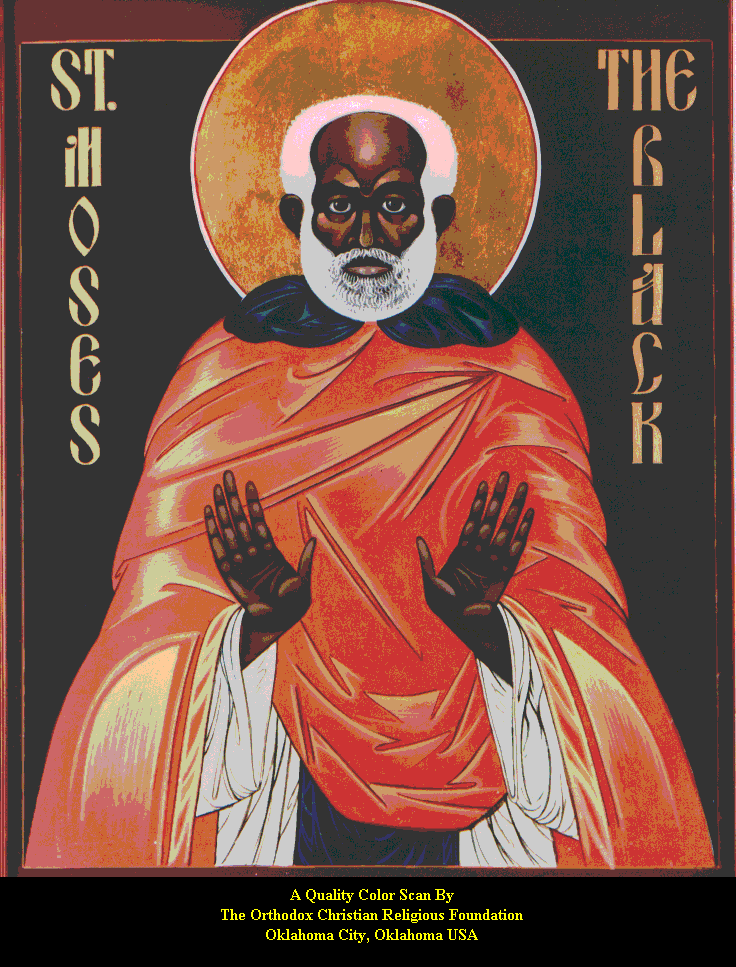
Saint Moses The Black is one of the most revered and venerated of the Orthodox saints. He is among a list of Orthodox saints from the continent of Africa who were instrumental in establishing the Christian Church throughout the world. The longer I am Orthodox, the more I am amazed at how ignorant I was about the history of the Church and its origins. It hadn't occurred to me that the Orthodox church in Africa predates Islam by some 600 years. I did not know that many of the slaves who were captured and brought to the North American continent were Orthodox Christians. I surely didn't know that African Americans are rediscovering their true spiritual roots and returning to the faith of their fathers in great numbers both on this continent and in Africa.
I had the pleasure recently of spending a few days with Father Moses, well, not the one pictured in the icon, but one who has honored him by taking his name. Father Moses Berry is an African American Orthodox priest who pastors a church in the Russian Arch Diocese in America. Father Moses is a priest with the mission of making all African Americans aware that to truly embrace their culture and roots they must return to the Orthodox Faith. To accomplish this, Father Moses has established the Brotherhood of St. Moses the Black. The Brotherhood is "a pan-Orthodox non-profit organization. Its mission is to minister to Americans the gift of Orthodoxy. In an effort to be good stewards of the manifold grace of God (1 Peter 4:10), the organization presents an annual conference that targets those who have little exposure to Orthodoxy as well as to the African roots of Orthodoxy."At the Conference, my knowledge of church history, doctrine, and my theological prowess, were dwarfed in the presence of some of the most reasoned, articulate and respected theological thinkers in our nation today. They are African-American and they are Orthodox. I had the privilege of sitting down one-on-one with the likes of Dr. Albert Roboteau, Professor of Theology at Princeton University. Being newly Orthodox myself, I marveled at how such a man as he, who teaches courses such as, African-American Religious History, Religious Radicals, Prophetic Voices in 20th and 21st century America, Holy Ordinary-the sacred in Contemporary Fiction, and Spiritual Dimensions of African-American Autobiography, had chosen the Orthodox faith above all others. He has answered well that question,
"When I was considering becoming Orthodox, a friend and fellow historian of African-American religion asked me if I understood how much Orthodoxy fit the aspects of African-American religion that had most personally interested me over the years. Several months earlier, an Orthodox monk had remarked to me how attuned he thought Orthodoxy was to the traditional spirituality of black people. Both comments took me by surprise. I had been so absorbed in the details of my own individual path toward Orthodoxy that I had failed to notice the forest for the trees, to discern the overall pattern my life was taking. Gradually after my chrismation, I began to reflect more generally upon the relationship between the faith of Ancient Christianity that had claimed me and the religious traditions of my people whose history I had been researching, writing, and teaching for the past twenty-five years. Since there are so few black Orthodox, it seemed like a lonely task. Providentially, a friend informed me of the conferences on Ancient Christianity and African-Americans, the purpose of which is to gather people from around the country to discover - in the context of prayer and the Divine Liturgy - the deep affinities and resonances between Orthodoxy and African-American spirituality. The resonances or points of convergence between Orthodoxy and African-American spirituality are profound. The first resonance is historical. Ancient Christianity is not, as many think, a European religion. Christian communities were well established in Africa by the third and fourth centuries. In Egypt and Ethiopia, Coptic traditions of worship, monasticism, and spirituality have remained authentically African and authentically Christian down to the present day.The second resonance is spiritual: there are important analogies between African traditional religions and Orthodox Christianity. In classical theological terms, these analogies constitute a protoevangelion: a preparation for the Gospel based on God's natural revelation to all peoples through nature and conscience." 
My personal epiphany was strengthened as I saw the devotion of the African-American Orthodox nuns who have devoted their entire lives to prayer and service. My European arrogance began to diminish as I heard Father Jerome Sanderson, Orthodox Priest and author of Saint Moses the Ethiopian from the African Saint Series, talk of the history of slavery and pointing out that his great grandparents were Orthodox Christians in Ethiopia when they were captured and put in shackles. The reality that Christianity is multi-racial, not only today, but from its very conception, struck me in such a way that allowed no more room for me to continue seeing in my own color. But, the hallmark of the Conference to me was the sharing in the Liturgy led by European, African American, African, Russian, and Serbian priests and deacons, all at the same altar, all at the same time, all in one accord. This is the church. This is the community of faith. The old childhood song, 
"Jesus loves the little children, all the children of the world, red and yellow, black and white, they are precious in his sight, Jesus loves the little children of the world",finally had real meaning.
"In modern times, there is a renewed fountain of ancient Orthodox Christianity. It is flowing throughout the entire world. This flow of spiritual life does not negate the rich tradition already developed in the crucible of suffering and the triumphs of character in America. Rather, it beckons all Americans to row into deeper waters-the waters of the ancient Christian movement that has been kept alive in the Eastern Orthodox church."

"Preserve oh God,
the Holy Orthodox Church
and all
Orthodox Christians
unto ages of ages
amen."
Kingdom Films

The logo here was designed by my wife, Cynthia. It is the Logo for my Independent Motion Picture Production Company, Kingdom Films. The dilemma I face is the fact that it was designed before I became Orthodox. The sword is a Catholic King's Sword and the banner reads Adventiat Regnum Tuus or Thy Kingdom Come, from the latin Vulgate. Initially I considered redesigning the logo but lately I have been wondering if I should change the name of the company. "Kingdom" to me, has always reflected a time when God and country were conjoined and the government ruled by theocratic principals. It was a time of honor, morality and chivalry. The problem I have run into is the fact that the word "kingdom" in the Bible Belt has been usurped by evangelical protestants and is used to identify religious movements, doctrines, and ideology that are not historic or Orthodox. The question I must often field is, "Do you produce Christian films?" To answer this question I am forced to deal with the asker's definition of "Christian". I have seen many "Christian" films and am convinced that if any one of them died at the box office it would not go to heaven. They are typically artistically poor, creatively lacking, narrow in scope, demagogue in message and completely embarrassing.
I do not make "Christian Films" for I find no place in scripture or tradition that allows for a film to have an eternal soul. If I could create a "Christian Film" I would surely be a little higher than the angels rather than a little lower. I am a Christian who makes films. I am an artist as is a painter, a sculpture, a dancer, a singer. I reflect the world and the state of the human condition through my art as would any of these. I am a reflection of my Creator. I create, for He creates. He has made me so. It is he who has created me and I detest any who would attempt to recreate me in their image of what a filmmaker should be.
I am still wading my way through my place in the Orthodox world in light of the fact that I am in an industry that is traditionally considered morally corrupt and a tool of anti-Christ. I would lay down my art in a second were I to believe that the film industry is the forbidden fruit and no person of faith is to eat of it. I, however, believe it is possible to be in the garden and obey God's restrictions. Surely to "be in the world but not of it" applies to the film industry as well.
In an attempt to define my creative and spiritual path as a filmmaker, I have published a Creed. It is not so much for those who would consider doing business with me as it is to set a standard before my eyes so that I will not falter.
KFI CREED
We believe the authentic art of filmmaking has intrinsic value and is divine in its origins.
We believe art does not earn value just because it serves some human intent; rather, it is inherently valuable because the very act of creating is a reflection of the Creator.
We believe there should be no segregation of "religious" and "secular" artistic subject matter, for reality, like God, is One.
We believe the depiction of debase human behavior as gratuitous entertainment is destructive to the individual and to society as a whole.
We believe the realistic, germane, artistic depiction of debase human behavior is not inherently the endorsement of it.
We believe "Adventiat Regnum Tuus" as an infinite truth.
This brings us back to the question of a name for my company. Considering all that you have read here, what do you think would be the best name for my company? Is there a company name that would reflect the values that I hold while assuring that I am not mistaken for an evangelical demagogue whose amateur films consist of three points and a prayer? Mel already has the apropos Icon Pictures. What should I have? With this question comes this announcement:
Thursday, July 20, 2006
The Church Around The World-or "Autocephalous" Isn't A Type Of Milk

Wednesday, July 19, 2006
Where Jesus "Blew It"- The Incarnation and the Body of Christ
"In the evening of the same day, the first day of the week, the doors were closed in the room where the disciples were, for fear of the Jews. Jesus came and stood among them. He said to them, 'Peace be with you,' and, after saying this, he showed them his hands and his side. The disciples were filled with joy at seeing the Lord, and he said to them again, Peace be with you.
'As the Father sent me so I am sending you.'
After saying this he BREATHED on them and said:
'Receive the Holy Spirit. If you forgive anyone's sins, they are forgiven; if you retain anyone sins, they are retained.'
So, Jesus blew it. He blew His Holy Spirit onto the Disciples. Why? He had already said He was sending the Comforter and, indeed, the Holy Spirit did come later at Pentecost. So, why did he blow it here prior to that? See what He said prior to blowing it, "As the Father sent me so send I you." To understand why He blew it, we must understand how and why the Father sent him. In this way we will understand how and why he sent the Disciples.
The Purpose
'Look, there is the Lamb of God that takes away the sin of the world. John 1:29
As Christ showed up for his baptism, an event that would launch his physical ministry on earth, John states as the purpose for Christ being sent, to "take away the sins of the world." Sin is what separates humanity from God and Christ was to take it away. Christ told the Disciples that just as God sent him so now He sends them...to take away the sins of the world.
The Preparation
There was an event of ratification at the launching of Christ's ministry.
'I saw the Spirit come down ON him like a dove from heaven and rest on him.' John 1:32-33
Christ blew ON the Disciples in John 20. Of course, the breath is the actual Spirit. As he breathed ON them, something demonstrably happened to them. Just as when the Spirit came ON Christ at his baptism, something demonstrably happened to Him. In another account of Christ's baptism Matthew recalls the voice of God,
'This is my son, the beloved: my favor rests ON him.' Matt. 3:16
"In Jewish literature a voice from heaven is a means of showing the God-given authority of a teacher.' (Page 1613 30-N note-New Jerusalem Bible) So, "as the Father has sent me, so I send you" established the Disciples in their role and mission with the provision of the Spirit resting on them. In this instance and in that room, it is the voice of Christ as fully God who bestows authority on the Disciples.
The failure to understand the incarnation of Christ and the results of that incarnation on the Body of Christ causes some to miss what happened in that room in John 20. Now Christ brings the Disciples into his dual identity. The Disciples are natural flesh yet, now they are provided with the super-natural nature of Christ. In this way His incarnation remains effective on earth as He goes back to the Father. In this way the Disciples, as a group, become Christ on earth or the "Body of Christ." The Disciples are to take away the sins of the world through the presence of the Spirit ON them as they proclaim this good news. They have become The Church and that Church is the place where the sins of men are taken away.
The Personification
"If you forgive anyone' s sins they are forgiven, If you retain anyone's sins they are retained." Yes, men are given the authority to forgive sins, but not just in their humanity is this done. Rather, man can do this because in his humanity, he has taken on the Spirit nature of Christ and become His Body. Humans make up the body of Christ. Christ decided it so. We are flesh and yet move within the supernatural. The gulf between Heaven and earth is suspended and we, as His Body, live in both just as he did-Fully God and fully man. Now, lest you misunderstand, we are not "Gods" as some assert. Christ was fully God yet was referred to as the Son of God. We are Sons of God also, joint heirs with Christ. The sons of God are gathered as ONE, as the Body of Christ, not as individuals as the Evangelical Protestant Ethos asserts. Herein lies the promise of power as we move and live in and through the Corporate Body He established. It is the Body of Christ that is given the attributes of Christ. It is the Church. Apostle Paul illustrates this union relating it to a husband and wife, "
"...and that is the way Christ treats the Church, because we are parts of his Body. This is why man leaves his father and his mother and becomes attached to his wife, and the two BECOME ONE FLESH. This mystery has great significance, but I am applying it to Christ and the Church."
So in the southern colloquial, "you" are not the Church, "you all" are the Church and that Church is united in flesh and Spirit. That means there is a tangible and there is a spiritual. The spiritual is seen when Christ blows it in John 20, but so is the tangible, because the result of Him blowing it is the creation of an authoritative, spirit empowered, physical entity. The physical part of the Church is the reason the Disciples had to replace Judas. "...Let another take his episcopacy." The Disciples were 12 in number. Do you recall seeing that number elsewhere? There were also 12 tribes of Israel. So the Trinity was in the midst of the Old Covenant and now in the midst of the New Covenant. It is within the those covenants that we "live and move and and have our being." It is in that physical structure that the Church exists and individuals are kept in the faith through the governance of their souls. The Old Covenant had Priests and the New Covenant has Priests, those who guard the souls of God's people and hold men accountable to God's standard of righteousness. So, from early on the Church has strived to maintain the "faith of the Apostles" because they were the authoritative initiators and presenters of all that Christ taught. If you will look at the revelation of John you will see the names of the original 12 etched with the original 12 tribes in the gates of the heavenly Jerusalem.
The Perpetuation
Ah, but did Christ really blow it, or was he short winded? He really should have thought further ahead, blown it a little harder. If only he had know that the Disciples were to die martyr's deaths. Such a tragedy. The Purpose was great, the Preparation was powerful, and the Personification was unprecedented but, after just a few hopeful years, the Disciples were dead and gone and the Church was dissolved. THE END...or was it...
"So I now say to you: You are Peter and on this rock I will build my community. And the gates of the underworld can never overpower it." (Matthew 16:18)
So much energy has been spent discussing the words "Peter" and "rock" that we often overlook the most relevant word in this scripture-COMMUNITY. The word here is qahal (hebrew) or ekklesia (greek) which means "an assembly called together." Each and every time this word is used it has as it's meaning an actual physical group with specific characteristics. It is never an ethereal, undefined, ungathered, disconnected group of people whose only connection on earth is an intangible spiritual philosophy or belief. This community is the community of the end times and is to "have its beginning here on earth in the form of an organized society whose leader he now appoints." (page 1637 16g note New Jerusalem Bible)
So the Disciples spread out taking the gospel into all the world. The Community established local communities all in harmony and communion with one another. After a while there was a local community in Jerusalem where it all started, then Antioch, Constantinople, Alexandria, and Rome. These were the five sees of the community or the five original Churches established by the Disciples. Now, if Jesus hadn't really blown it, it all would have stopped as each Disciple died off. But what happened? The Church continued in continuity and unity and does so to this day. It is called the Orthodox Church whose Bishops still guard our souls and still preserve the Faith of our Fathers. All because Jesus blew it.
Tuesday, July 18, 2006
The Mother of God?
ORTHO: Theotokos is greek for " Mother of God".
PROTEST: I have a problem with calling her "Mother of God".
ORTHO: Then, who was she the mother of?
PROTEST: She gave birth to Jesus.
ORTHO: And giving birth makes you a...
PROTEST: Mother.
OTHRO: Then Mary was the mother of...
PROTEST: Jesus.
ORTHO: And Jesus is...
PROTEST: God.
ORTHO: Then Mary is the Mother of God.
PROTEST: I have a problem with calling her that.
ORTHO: Apparently.
In my Protestant years which included being raised in a Baptist Pastor's home and a BA in Religion from a Baptist University all I knew about Mary, the mother of Jesus, was what I saw in the pages of the Gospels. I also never heard a sermon about the Mother of our Lord although she was mentioned at Christmas time. Even referring to her as "the Mother of our Lord" was frowned upon even though the phrase is directly from scripture. The fear, it seems in the Protestant world, is that Mary might be given due belonging only to God. It is this mindset that allows for inaccurate accusations toward the Orthodox faith concerning Mary. Three things have helped me gain a balanced perspective concerning this matter. One, is that there is a difference between "venerating" and "worshiping." You do not worship the photo of your Mother that may hang on your wall, but you do venerate it.Venerate: to regard with reverential respect or admiring deference.
So, if the Archangel can say Mary is Blessed and that all men shall call her so, then I can and should venerate her as the whole church has done for 2000 years. She was and is the greatest example of holiness and servitude to God and was the first to receive the Christ for who he was and in quite a demonstrative way.
Secondly, I had to be honest about this question: "Where is Mary right now?" She isn't dead. She is in heaven. Is she lost in some corner somewhere because she is "just another person and no more important than any other" as some have suggested or is she with her son worshiping around the throne? If she is there with Jesus, can I ask her to pray for me? It has always been common of the church to ask the saints, the "great cloud of witnesses", to pray for us and this includes the Mother of God. Most Protestants believe there are some measures of crowns or rewards in heaven. Wouldn't Mary receive a special place or reward, or focus? The church has always held this to be true.
Thirdly, I like how my priest Father Steven Rogers put it: "We don't get to God through Mary, he came to us through her." It is in this way that she is the "mediator." Christ became incarnate by choosing a purified and holy human vessel.
Let's see how the Early Church Father's referred to Mary:
Irenaeus
"The Virgin Mary, being obedient to his word, received from an angel the glad tidings that she would bear God" (Against Heresies, 5:19:1 [A.D. 189]).
Hippolytus
"[T]o all generations they [the prophets] have pictured forth the grandest subjects for contemplation and for action. Thus, too, they preached of the advent of God in the flesh to the world, his advent by the spotless and God-bearing (theotokos) Mary in the way of birth and growth, and the manner of his life and conversation with men, and his manifestation by baptism, and the new birth that was to be to all men, and the regeneration by the laver [of baptism]" (Discourse on the End of the World 1 [A.D. 217]).
Gregory the Wonderworker
"For Luke, in the inspired Gospel narratives, delivers a testimony not to Joseph only, but also to Mary, the Mother of God, and gives this account with reference to the very family and house of David" (Four Homilies 1 [A.D. 262]).
"It is our duty to present to God, like sacrifices, all the festivals and hymnal celebrations; and first of all, [the feast of] the Annunciation to the holy Mother of God, to wit, the salutation made to her by the angel, ‘Hail, full of grace!’" (ibid., 2).
Peter of Alexandria
"They came to the church of the most blessed Mother of God, and ever-virgin Mary, which, as we began to say, he had constructed in the western quarter, in a suburb, for a cemetery of the martyrs" (The Genuine Acts of Peter of Alexandria [A.D. 305]).
"We acknowledge the resurrection of the dead, of which Jesus Christ our Lord became the firstling; he bore a body not in appearance but in truth derived from Mary the Mother of God" (Letter to All Non-Egyptian Bishops 12 [A.D. 324]).
Methodius
"While the old man [Simeon] was thus exultant, and rejoicing with exceeding great and holy joy, that which had before been spoken of in a figure by the prophet Isaiah, the holy Mother of God now manifestly fulfilled" (Oration on Simeon and Anna 7 [A.D. 305]).
"Hail to you forever, you virgin Mother of God, our unceasing joy, for unto you do I again return. . . . Hail, you fount of the Son’s love for man. . . . Wherefore, we pray you, the most excellent among women, who boast in the confidence of your maternal honors, that you would unceasingly keep us in remembrance. O holy Mother of God, remember us, I say, who make our boast in you, and who in august hymns celebrate your memory, which will ever live, and never fade away" (ibid., 14).
Cyril of Jerusalem
"The Father bears witness from heaven to his Son. The Holy Spirit bears witness, coming down bodily in the form of a dove. The archangel Gabriel bears witness, bringing the good tidings to Mary. The Virgin Mother of God bears witness" (Catechetical Lectures 10:19 [A.D. 350]).
Ephraim the Syrian
"Though still a virgin she carried a child in her womb, and the handmaid and work of his wisdom became the Mother of God" (Songs of Praise 1:20 [A.D. 351]).
Athanasius
"The Word begotten of the Father from on high, inexpressibly, inexplicably, incomprehensibly, and eternally, is he that is born in time here below of the Virgin Mary, the Mother of God" (The Incarnation of the Word of God 8 [A.D. 365]).
Epiphanius of Salamis
"Being perfect at the side of the Father and incarnate among us, not in appearance but in truth, he [the Son] reshaped man to perfection in himself from Mary the Mother of God through the Holy Spirit" (The Man Well-Anchored 75 [A.D. 374]).
Ambrose of Milan
"The first thing which kindles ardor in learning is the greatness of the teacher. What is greater than the Mother of God? What more glorious than she whom Glory Itself chose?" (The Virgins 2:2[7] [A.D. 377]).
Gregory of Nazianz
"If anyone does not agree that holy Mary is Mother of God, he is at odds with the Godhead" (Letter to Cledonius the Priest 101 [A.D. 382]).
Jerome
"As to how a virgin became the Mother of God, he [Rufinus] has full knowledge; as to how he himself was born, he knows nothing" (Against Rufinus 2:10 [A.D. 401]).
"Do not marvel at the novelty of the thing, if a Virgin gives birth to God" (Commentaries on Isaiah 3:7:15 [A.D. 409]).
Theodore of Mopsuestia
"When, therefore, they ask, ‘Is Mary mother of man or Mother of God?’ we answer, ‘Both!’ The one by the very nature of what was done and the other by relation" (The Incarnation 15 [A.D. 405]).
Cyril of Alexandria
"I have been amazed that some are utterly in doubt as to whether or not the holy Virgin is able to be called the Mother of God. For if our Lord Jesus Christ is God, how should the holy Virgin who bore him not be the Mother of God?" (Letter to the Monks of Egypt 1 [A.D. 427]).
"This expression, however, ‘the Word was made flesh’ [John 1:14], can mean nothing else but that he partook of flesh and blood like to us; he made our body his own, and came forth man from a woman, not casting off his existence as God, or his generation of God the Father, but even in taking to himself flesh remaining what he was. This the declaration of the correct faith proclaims everywhere. This was the sentiment of the holy Fathers; therefore they ventured to call the holy Virgin ‘the Mother of God,’ not as if the nature of the Word or his divinity had its beginning from the holy Virgin, but because of her was born that holy body with a rational soul, to which the Word, being personally united, is said to be born according to the flesh" (First Letter to Nestorius [A.D. 430]).
"And since the holy Virgin corporeally brought forth God made one with flesh according to nature, for this reason we also call her Mother of God, not as if the nature of the Word had the beginning of its existence from the flesh" (Third Letter to Nestorius [A.D. 430]).
"If anyone will not confess that the Emmanuel is very God, and that therefore the holy Virgin is the Mother of God, inasmuch as in the flesh she bore the Word of God made flesh [John 1:14]: let him be anathema" (ibid.).
John Cassian
"Now, you heretic, you say (whoever you are who deny that God was born of the Virgin), that Mary, the Mother of our Lord Jesus Christ, cannot be called the Mother of God, but the Mother only of Christ and not of God—for no one, you say, gives birth to one older than herself. And concerning this utterly stupid argument . . . let us prove by divine testimonies both that Christ is God and that Mary is the Mother of God" (On the Incarnation of Christ Against Nestorius 2:2 [A.D. 429]).
"You cannot then help admitting that the grace comes from God. It is God, then, who has given it. But it has been given by our Lord Jesus Christ. Therefore the Lord Jesus Christ is God. But if he is God, as he certainly is, then she who bore God is the Mother of God" (ibid., 2:5).
Council of Ephesus
"We confess, then, our Lord Jesus Christ, the only begotten Son of God, perfect God and perfect man, of a rational soul and a body, begotten before all ages from the Father in hi
s Godhead, the same in the last days, for us and for our salvation, born of Mary the Virgin according to his humanity, one and the same consubstantial with the Father in Godhead and consubstantial with us in humanity, for a union of two natures took place. Therefore we confess one Christ, one Son, one Lord. According to this understanding of the unconfused union, we confess the holy Virgin to be the Mother of God because God the Word took flesh and became man and from his very conception united to himself the temple he took from her" (Formula of Union [A.D. 431]).Okay. So maybe she is the Mother of God.
Saturday, July 15, 2006
The Journey of a Hobbit Priest
Father Denzil Roland, my former priest in the Charismatic Episcopal Church, once told me he thought he might be a contented man just to live in the hills and raise chickens. He being "the most unlikely of men to serve as a priest", as he puts it. I have always lovingly referred to him as a "sawed-off hobbit of a priest". His short stature and robust build, his burley beard and personable demeanor, his cultural speech interlaced with an occational "I seen it" and "I done it", causes some, at first glance, to miss the powerhouse of a man he is. His power comes not from his keen mind, uncanny literary retention, masterful ability as a wordsmith, relentless pursuit of truth and holiness, but from his unwavering heart of servanthood. Christ said the servant is the greatest of all. That being true, I deem it an honor to have served at the altar with one such as he.Father Denny, as he is most often called, celebrated his 10th year in the Charismatic Episcopal Church July 1, 2006. On that day, at his own request, he was released from his Holy Orders as a priest in the CEC to pursue Holy Orders with the Antiochian Orthodox Church. Little did I know or even dream possible that when we, two years ago, asked him to release us from his pastorate in the CEC Church so that we might become Orthodox, he too would soon step over into the One Holy, Catholic, and Apostolic Church which is the Orthodox Church.
I am humbled and amazed at the work of God in the life of Father Denny. I am especially expectant for the Bishop of the Orthodox Diocese in which we serve, to know Father Denzil Roland as I have known him. The Church has been blessed this year by his entrance into the undivided faith of our fathers. I long for the day when I attend Father Denny's Chrismation service and am able to utter the words, "Welcome home Father. You have reached the destination and now the real Journey To Orthodoxy begins."
Thursday, July 13, 2006
What Heaven Looks Like!
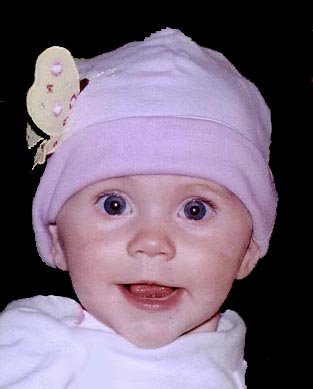
The more accurate title would be "What Heaven on Earth Looks Like". I don't know a better way to illustrate the title than to share with you this picture of my granddaughter, Lily. Why the reference to heaven? The obvious reference is the state of angelic ecstasy any of us feel when we look upon or embrace a child that we love, be it as parent, grandparent, aunt, or uncle. I have found the Kingdom of God becoming more tangible to me as I watch such innocent heavenly beings participate in the Orthodox Liturgy week after week. I watch with a heart of worship as parents or grandparents carry a child or lead them by the hand to light a candle and pray, or as the child is lifted up so they can kiss and venerate the icon of Mary or of Christ. The power of Heaven is most displayed and the Kingdom of God is closest it seems, when a three year old boy pauses before the the altar and bows as he crosses himself or a little hand reaches out to touch the hem of the priest's garment as he passes or a beautiful little girl opens her mouth and willingly receives the body and blood of our Lord in the Eucharist. Some parents of young children, who are making the Journey to Orthodoxy, are surprised or even disappointed that the Orthodox Church for the most part do not have nurseries for all ages during the Liturgy. The Protestant ethos has taught them a culture of segregation or separation. These parents have become accustomed to dropping the kids off in their nursery or Sunday school class and leaving them in someone else's care during the church service. The ethos of the Orthodox faith is one of community and family. The Liturgy is vital for everyone. Entire families, young and old, are present most of the time sitting together as a unit. I have watched with amazement the blending of the reverence and holiness of the Liturgy amidst the occasional noise from a baby or the typical toddler's banter followed by a mother's "shhh." In an Orthodox Liturgy this is all normal. The family is together as is the whole family of God in that Liturgical service of worship, all around the thrown of God with the saints of all the ages. That's What Heaven on Earth Looks Like because that's What Heaven Looks Like. My wife Cynthia and I understand the stress of caring for young children, having had five of our own. We understand the need for time to ourselves. We too, were also accustomed to the "break" that the one or two hours in church without the kids gave us to recharge our own spiritual batteries. It can be a challenge to adjust to the Orthodox way of inclusion, but think about it. We are converts to the faith. Because we include our children and not seclude them, they will grow up in the faith. They will be "Cradle Orthodox" and so will your grandchildren. Please pardon me if I envy you this time in your life. I wish we had found the one true faith when our children were young. Oh, for the opportunity you have! As distracted and stressed out you might be at times during the Liturgy, your children will grow. They will settle in. They will take on the true spirit of worship and so will you, for what better worship can you offer to the Holy Trinity than to present your children to Him week after week? Don't let the challenge of transitioning to being an Orthodox Parent keep you from the Church and the eternal benefits that await you and your entire family.
Sunday, July 09, 2006
"Freedom In Worship" or Is Orthodoxy Charismatic?
WHERE IS THE VALIDITY?
Just so you will fully understand my perspective please know that I am considered a prophetic person. (Although I don't claim to be a Prophet). I have given prophetic words by the will of God in public and in private. I have seen angels and have experienced spiritual visions and dreams. I have been a Charismatic musician and worship leader, and have written many worship songs. I have danced in the spirit, spoken in tongues and been "slain in the spirit". I have also served on staff at several non-denominational Charismatic Churches as worship leader and associate pastor. I believe fully the power of the Holy Spirit and the existence of all the gifts that are found in Him. What I have discovered and what I have had to humbly admit is that much of what I saw in the Charismatic Movement was not authentic; in fact much of what I saw and experienced was wrought with deception. Although we should not judge the motive of people's hearts, we have the responsibility to judge the results of that done in the name of Christ. My most shocking epiphany was when I realized that 99.9 % of the so-called miracles, healings, and prophetic words were nothing more than anecdotal fables, wishful thinking, or soulish activity that could not be verified. Not only could they not be verified but in
most cases there is no requirement that they be verified. Because so much of the Charismatic manifestations have been proven to be false, a new twist on a scriptural doctrine has had to be embraced. One Charismatic leader states the premise of this new doctrine concerning prophetic words, "In Pentecostal circles, we differentiate between primary revelation, which is the Bible and which we consider infallible, and secondary revelation prophetic utterances that we do not consider infallible." So to them it is okay to give an erroneous "prophetic word" that directly affects the response and lives of individuals with no accountability toward its authenticity. When it comes to the thousands of healing "miracles" that don't take, the doctrine is espoused that either they didn't have enough faith, they need to work to "keep their healing", or they just received a partial healing. An honest student will have to admit that ALL of the scriptural healings were 100% and unquestionable and if a prophet erred in even one point of his message he was deemed a false prophet and was stoned. As a former Evangelical Charismatic, my eyes were really opened when I began to read actual documentation of prophecies and healings that were verifiably false (See www.deceptioninthechurch.com). What was especially shocking was the blatant false doctrines also espoused by the prophets and healers such as, "You don't have God in you. You are a God!", the belief that God consists of nine parts not three, and the uncanny parallels between the latest manifestations happening in the latest Charismatic revivals and the cults of the eastern gurus (See www.bible.ca/tongues.htm). Without going into a thorough apologetic discourse to these points I will trust the integrity of your search to discover the accuracy of this assessment. COMPARE THE ORTHODOX AND CHARISMATIC WORSHIP ETHOS
There is a vast difference in the worship ethos of the west and that of historic Christianity which has its ethos origins in the east. Evangelical Charismatics value highly the idea of the invisible church or "everyone is a priest" doctrine and thus devalue the sanctity of worship implements or places of worship. Charismatics are comfortable calling their buildings auditoriums or centers. Even those who refer to their places of worship as "sanctuaries" have no qualms about taking cokes or coffee inside or having ordinary conversations of earthly matters. With few exceptions they enter into the building to the sound of a loud roar of conversation. The "call to order" is usually the band or choir striking up the music causing all to scramble to their seats. In Orthodoxy the word "sanctuary" is taken literally. The Temple is specifically "set apart" for the worship of God. The architecture itself lends itself to the Old Testament Temple with the outer court, the inner court, and Holy of Holies. Where individual expression is the hallmark for worshipers in an Evangelical Charismatic service, in Orthodoxy the goal is for all to worship with one voice. Each person enters the door in reverence and quietness paying respect to the Saints who have gone on before by venerating their pictures. They then enter the inner court and light candles, pray, and bow in the direction of the Holy of Holies where the Altar rests. There is always an awareness that one is in the presence of the Holy Trinity, the Host of Angels, and the Great Cloud of Witnesses who are the Saints that continue to worship around the throne of God with us. 90% of the Liturgy is scripture and sung corporately to the Trinity and the people stand 90% of the time out of respect for what is being said and done. The contents of the gospel book are revered and people show respect by kissing the cover as the priest presents it. The priest is shown honor and respect as he represents Christ to the people. Some touch the hem of his vestment as he passes in remembrance of Christ passing by or kiss his right hand when greeting him because it is that hand that blesses and holds the Eucharist. The Altar area itself is reserved only for those who are sanctified to minister there. It is not treated as a common area or a simple platform stage as in most Evangelical Charismatic Churches. If something comes in contact with the Altar it is treated as holy and with respect. The public Charismatic expressions have always been subject to confusion and infiltration of error and always considered an aberration of the shape and ethos of Christian Worship. Saint Saraphim of Sarov (1759-1833) who once spent 1000 days and nights in prayer on a rock and later died in the kneeling position while in prayer, speaks of the ethos of holiness required by all who come to corporate worship:What a drastic contrast to the noisy self-promoting environment of the Evangelical Charismatic ethos where the criteria for spirituality is how well one can prophecy or how "anointed" the music set was!
What I discovered through the perusing of history and the writings of the Early Church Fathers was that it is the Orthodox Church that is the model of the early Church worship not the modern Charismatic culture. The early Christians were Jewish. They continued to worship at the synagogue on Saturday and to meet in houses on Sunday, or what came to be known as The Lord's Day. As the Lord's Day meetings continued to develop they continued the structure and order of the synagogue services. It was anything but the free-wheeling "no agenda" atmosphere. Everything was done "decently and in order" as Paul would later state when the Corinthians public usage of some of the spiritual gifts became unbalanced and led to confusion. The work or praise of the people (liturgy) was centered around the Eucharist and all that led up to the partaking of it was designed to tell the whole gospel story. History has provided us with documentation to this effect. In Justin Martyr's First Apology, c. 150 A.D we see the shape of the Liturgical service that the Church has preserved even to today.So, does the worship in the Orthodox Church look Charismatic as we have discussed? The answer is "no". But I would not trade one Liturgy for all the Charismatic "freedom" in the world. One of the greatest spiritual moments I have had since becoming Orthodox was during the Liturgy. As we were all singing, suddenly my propensity for individual desires, personal tastes and preferences in worship based on my own cultural passions fell away and I became part of the whole. We were all singing with one voice. Let me say it again: it was as if one person was singing. I didn't lose my own identity and yet it was melded with the others present and the Saints of the ages who were also present just as the Church has maintained for 2000 years. The Charismatic world has many catch-phrases, one of them being "open heaven". You might hear someone say, "We are praying for an open heaven," or, in reference to the newest Charismatic movement, "There is an open heaven over there." Heaven is truly open every time the Orthodox Liturgy ("work" or "glory" of the people) takes place and we have, not just some ethereal move of the Holy Spirit, but the fullness of the Holy Trinity in our midst and we actually take the Presence of Christ into our bodies by way of the Eucharist.